The Sun reflected in the surface of a strange pool in Haldon Forrest car parking, near to the now-defunct CCANW – Centre for Contemporary Art and the Natural World. I think the centre was showing an exhibition by local artist Tabitha Andrews. As I was filming we were approached by Emily Allan – an ex-foundation student from PCAD – who introduced us to Paula Orrell, who was about to take up a curatorial post at Plymouth Arts Centre.
Super 8 filming underwater using my Eumig Nautica waterproof camera. Kayla’s brother Miles floats on the surface as I film him from below using scuba gear off West Hoe, Plymouth.
Grass caught in a fence on Dartmoor. We parked behind the Plume of Feathers pub in Princetown and walked towards South Hessary Tor. It was bitterly cold, Kayla carrying her heavy Bolex. I filmed with the weighty Canon 1014, using its lap-dissolve facility. The dried grass looked beautiful in the wind – it’s molinia and a real nuisance on the moorland.
What year was this? I’ve no idea. Maybe there is metadata with the film strip – not date and time, but implied metadata such as the film type. Perhaps shots before or after on the roll would give a clue. The lap-dissolves on the the grass tells me that it was filmed with the 1014 because its predecessor, in the sense that I traded one camera for the other, a Canon 814 didn’t have that facility. Now when did I buy the camera? Lees Cameras in London, and I remember using the 1014 at Beaumont Avenue before we moved out in 1994. So it could be any time after 1989…
The Sun reflected in the surface of our garden pond, in the 90s or 2000s. The pond is formed from the foundations of a WW2 air-raid shelter to the rear of the house. The front door is a bit crooked as a large bomb exploded 5m away in the street in The Blitz. Plymouth has a ‘bomb book’ where the impacts were mapped each day by the City Council. Our house was already 50 years old at the time. It has flawed glass panes in the front windows that were probably replaced after the blast. The next road has two newer ‘infill’ houses as two adjacent homes in the terrace were destroyed by a bomb.
When we first introduced fish to the pond they were given names.
The muslin curtain blown by the breeze through the open bedroom window at Beaumont Avenue. To the left was a ‘vintage’ pink moulded plastic splash-back with chrome metal fixtures for two toothbrushes and his-n-hers water tumblers. It’s probably still there as the landlord moved back after we left, having been ousted from his role as director by a coup from Plymouth Art Centre, where he’d lived and worked.
Beautiful filming of sparklers through a photographic enlarger’s condenser lens. The tiny house on Beaumont Avenue in Plymouth was the studio space for a lot of experimentation in the 1990s. This was filmed in the upper front room which served as studio and office space.
I had been experimenting with lenses to create an aerial image in front of a projector for transferring to video without filming the projected image on a white wall or piece of paper. The filming is spectacular, what’s less obvious are the small autobiographical elements. At the time I was spending a lot of time in photographic darkrooms, developing, printing and teaching. Some of the paraphernalia made it home such as the enlargers’ condenser lenses.
A very early piece of Super 8 filming, on St Andrew’s Cross roundabout. I had walked up the hill from Plymouth Video Workshop, based in Plymouth Arts Centre circa 1987/8.
I had learned photography at college as part of my biology course, and developed video skills in the workshop, but Super 8 was a new adventure. I recall playing this film on a Bolex back-projector and hearing Annette Kemp, the workshop director, commenting on the beautiful footage to someone on the phone. At some stage the word ‘film’ was added to the name, becoming Plymouth Film and Video Workshop. This was the beginning of an understanding that there was something of a schism between filmmaking and the newer independent video production. This line was blurred for me as I’d come to video via photography which was all ‘analogue’ at the time.
[Having selected the first shot, the following second of footage appended to the editing timeline contains an in-camera edit, that I discovered at the end of the month when reviewing the whole sequence.]
The living room mantlepiece in Beaumont Avenue with daffodils and artwork from Plymouth Art Centre where I worked in the film workshop, but also as a gallery technician for Artangel’s James Lingwood and then Rosie Greenlees.
Working at the Art Centre was a wonderful education having come from a science background: contemporary visual art and artists, huge events like TWSA 3D, driving exhibitions around the country and a whole new world of film to absorb in the cinema.
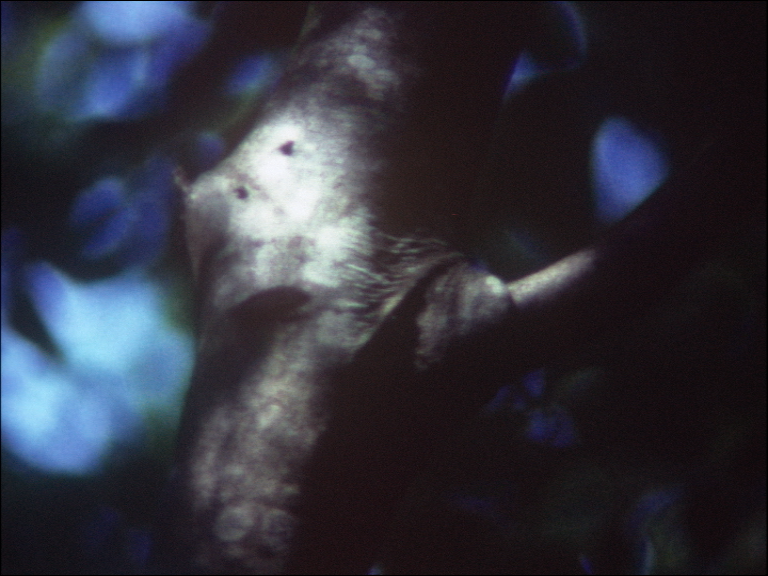
Sunlight dancing on the trunk of a tree in Plymbridge Woods, used in our film Project. I remember the filming day well, but I’m not sure whether this was shot with my Canon or the underwater Eumig Super 8 camera. There is lovely footage filmed just under the surface of the River Plym and the memory of the icy water on my bare feet is as clear as if it was yesterday.
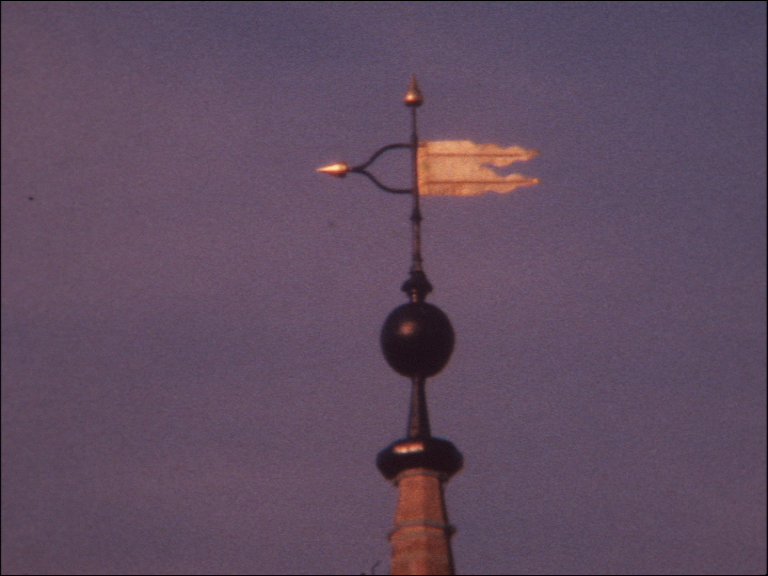
The weather vane on top of Charles Church in Plymouth, filmed from the now-demolished multi-storey carpark adjacent to the also-demolished Drake’s Circus shopping centre. There are only a few shots – a couple like this and a tilt up the spire. All these years later I can feel the smooth, solid concrete of the wall I leaned on to set up the tripod.
The filming was for my SWA-funded ‘Film About Plymouth’. I’d never noticed the vane before starting this project, the old ruin had just faded into the background through familiarity.
I drove to the top of the spiral car park and set up a tripod beside the thick concrete wall, facing the roundabout which has surrounded the church for decades. The sun caught the weathervane as it turned with the wind. The traffic circulated below, marooning the church on an island in a stream of traffic.
The church – fire-bombed in WW2 – was preserved as a ruined memorial to all those Plymothians who lost their lives in the conflict. Almost everything else in its immediate vicinity has been demolished at least once, with just some alms houses to the north-east side and part of a listed post-war garage to the south-west. When Abercrombie’s Plan for Plymouth relaid the roads, the church’s graveyard was dug up to create the roundabout. To the south-east corner the traffic passes just a few feet from the ancient walls.
It’s amazing that this shot of the weather vane gives no clue to the ruin below, nor the brutalist car park (now demolished) from which it was filmed. Dylan Trigg describes how ruins bear witness to trauma, different to the more usual oral histories. The church is in a state of ‘suspended ruination’ – windowless and with no roof excepting the spire. The interior area is grassed where the congregation sat, and closed off with a locked iron gate.
Our electrician Bill Dawe told me how he had been taken as a young child to the church by his mother a few days after it burned. The heat was so intense it had destroyed the roof. Bill and him mum collected the copper nails from rubble of the slates – with the vicar’s permission, he noted – loaded them into the pram and sold them to a scrap metal dealer.
June, our near-neighbour in Beaumont Avenue, just up the hill from the church, described how her nearby childhood neighbourhood had been flattened after the war. For her, the church was a memorial to this loss as well as the trauma of war.
The car park had an exciting helter-skelter tight spiralling exit ‘road’ at its centre.
2019 – the four ‘pineapples’ at the tower’s corners below the spire have been replaced with newly carved replicas as the originals were unsafe. Cost is £100,000.