

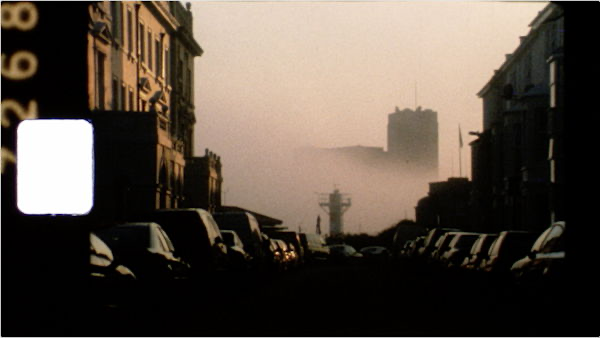
Sea Front serves as a case study for the remediation choices that were made for the Super 8 practice experiments that follow. The first digitisation was a home telecine using a standard definition miniDV digital video camera to film the projected image. As described earlier, I set the projector to 18 fps and slowed it slightly to reduce flicker in the captured video. The editing was carried out in its native 50i interlaced format. The finished film won an award at the London Short Film Festival, despite, or perhaps because of, the ‘unprofessional’ low resolution rendition of the Super 8 footage which pulses – an effect caused by the frequency of the rotating projector blades.
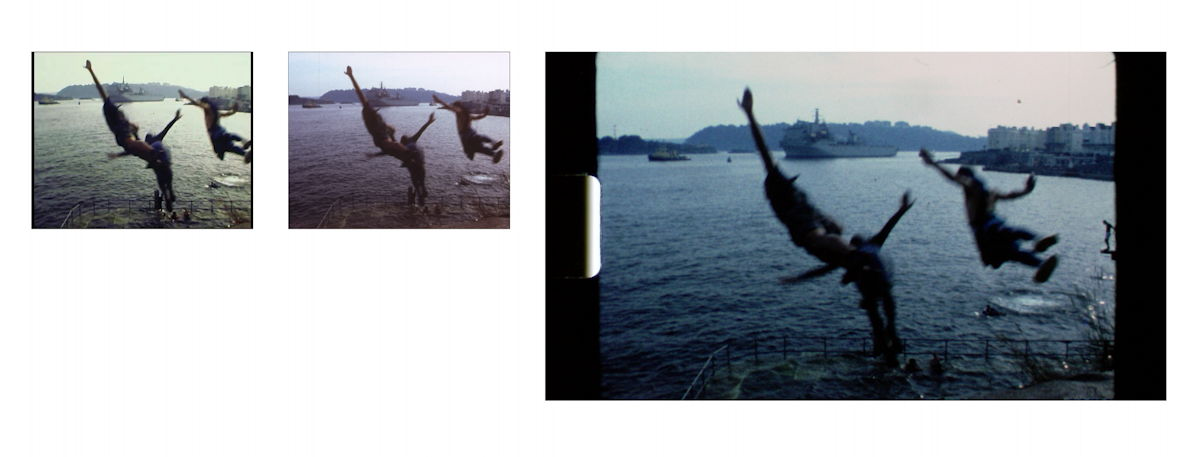
A screen grab from this home transfer is seen on the left above. The professional telecine conducted by Deluxe in London, described is in the centre. Although this was standard definition (SD), it was more detailed and did not exhibit the previous iteration’s pulsing. I recreated the video edit of Sea Front using the Deluxe scan that was carried out at 25 fps. During editing I slowed the footage to preserve the ‘feel’ of the first award-winning edit. Technology has developed rapidly making high quality scanning much more affordable, but it would still be expensive and time-consuming to re-digitise all my archive at HD or higher resolution. I did take a selection of Super 8 material to Bristol in 2019 for an HD scan where each film frame is captured to a progressive video file. The Super 8 film passed in front of a lens on the scanner, rather than across the physical gate of a projector or telecine machine. This process is gentle on the physical film and allows the whole width of the film to be scanned as shown in Figure 18 or zoomed in to the picture area as in the right-hand image above.
Womad (2016) was edited using the Deluxe SD telecine footage and was screened on a Sony Cube 27″ monitor. This obsolete 4:3 ratio CRT television displayed the SD material at its best. The difficulties of screening SD interlaced video on an HD flatscreen, and the strategies to cope with the mismatch are discussed in Skimming the Archive on pages 93-98.