

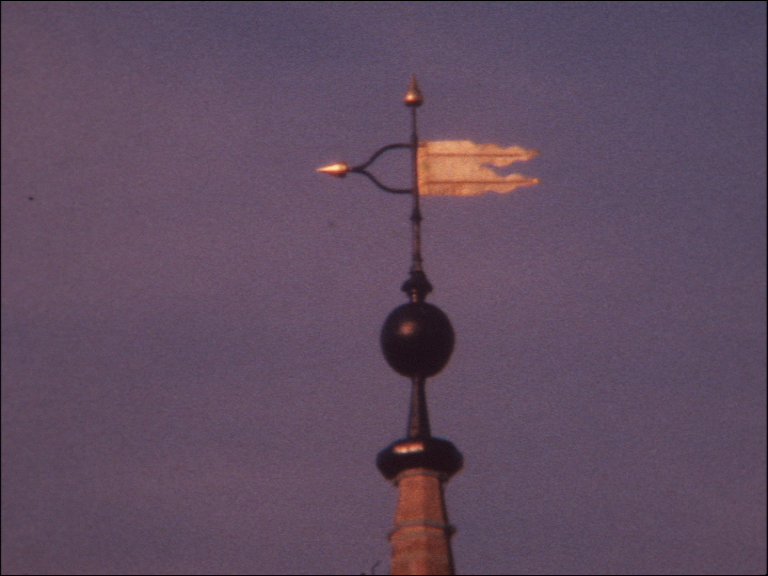
The weather vane on top of Charles Church in Plymouth, filmed from the now-demolished multi-storey carpark adjacent to the also-demolished Drake’s Circus shopping centre. There are only a few shots – a couple like this and a tilt up the spire. All these years later I can feel the smooth, solid concrete of the wall I leaned on to set up the tripod.
The filming was for my SWA-funded ‘Film About Plymouth’. I’d never noticed the vane before starting this project, the old ruin had just faded into the background through familiarity.
I drove to the top of the spiral car park and set up a tripod beside the thick concrete wall, facing the roundabout which has surrounded the church for decades. The sun caught the weathervane as it turned with the wind. The traffic circulated below, marooning the church on an island in a stream of traffic.
The church – fire-bombed in WW2 – was preserved as a ruined memorial to all those Plymothians who lost their lives in the conflict. Almost everything else in its immediate vicinity has been demolished at least once, with just some alms houses to the north-east side and part of a listed post-war garage to the south-west. When Abercrombie’s Plan for Plymouth relaid the roads, the church’s graveyard was dug up to create the roundabout. To the south-east corner the traffic passes just a few feet from the ancient walls.
It’s amazing that this shot of the weather vane gives no clue to the ruin below, nor the brutalist car park (now demolished) from which it was filmed. Dylan Trigg describes how ruins bear witness to trauma, different to the more usual oral histories. The church is in a state of ‘suspended ruination’ – windowless and with no roof excepting the spire. The interior area is grassed where the congregation sat, and closed off with a locked iron gate.
Our electrician Bill Dawe told me how he had been taken as a young child to the church by his mother a few days after it burned. The heat was so intense it had destroyed the roof. Bill and him mum collected the copper nails from rubble of the slates – with the vicar’s permission, he noted – loaded them into the pram and sold them to a scrap metal dealer.
June, our near-neighbour in Beaumont Avenue, just up the hill from the church, described how her nearby childhood neighbourhood had been flattened after the war. For her, the church was a memorial to this loss as well as the trauma of war.
The car park had an exciting helter-skelter tight spiralling exit ‘road’ at its centre.
2019 – the four ‘pineapples’ at the tower’s corners below the spire have been replaced with newly carved replicas as the originals were unsafe. Cost is £100,000.
https://www.plymouthherald.co.uk/news/plymouth-news/four-giant-pineapples-charles-church-313111