

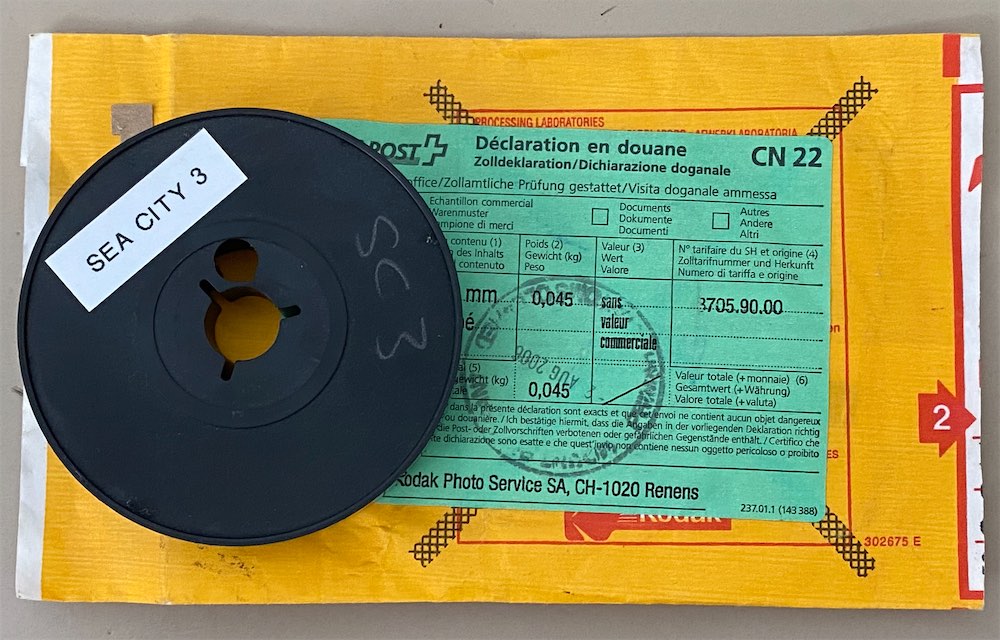
You know the rushes are there, and you remember them, although the memory fades, you know they’re still there, so you know they are not lost.
In 2006 I started making a short film for a collaborative project called Super 8 Cities. Each contribution from around the world would feature a city filmed within the same set of rules or parameters. The project rules forbade panning with action and required a frame rate of 24fps to give the disparate films a stylistic coherence. The recently discontinued Kodachrome film – for me the essence of the Super 8 experience – was selected for the project. My film Sea City would follow the coastline through Plymouth from east to west.
The footage was shot as the journey of a flâneur along the coastal path – the liminal land/sea southern boundary of the City of Plymouth. The flâneur, in the modernist sense, seemed an appropriate stance for the filmmaker as the route traversed the varied and disparate results of urban planning, from the semi-derelict industrial to accessible tourist spots. Patrick Keiller suggests:
“The present day flâneur carries a camera” and warns of “the lonely life of the street photographer, who acts the flâneur in the hope of recording glimpses of the marvellous with his camera. His is a difficult task, for poetic insights so rarely survive their capture on the emulsion.” (Keiller, 1981/2)
The Film
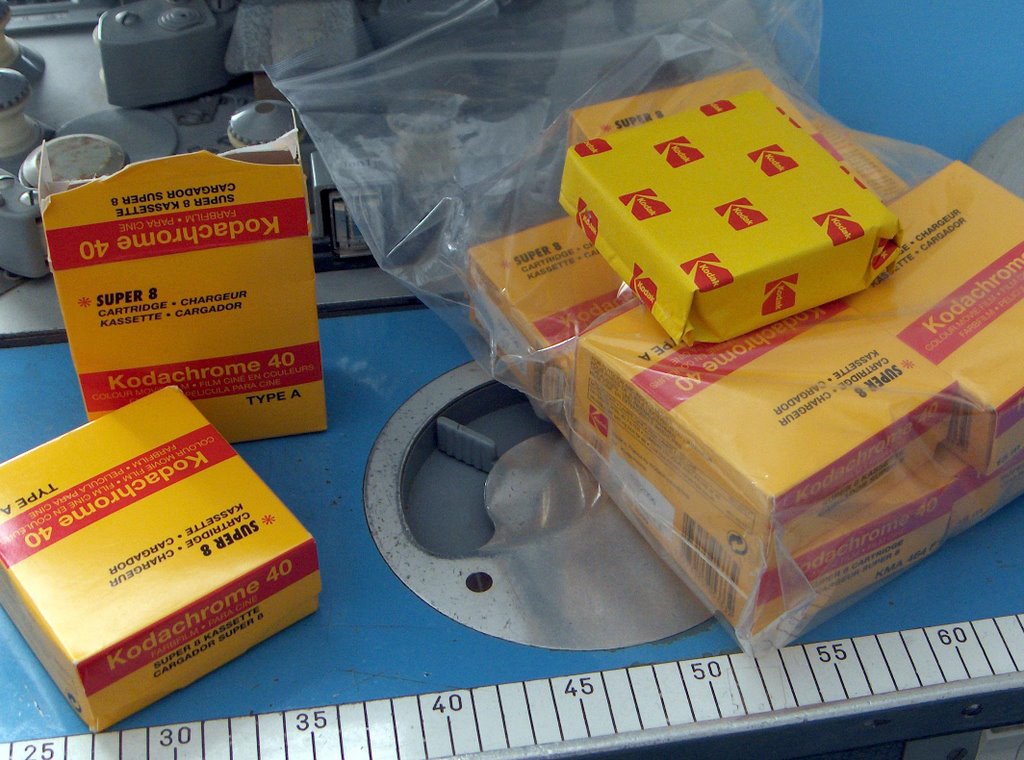
Nine cartridges of Kodachrome K40 colour reversal were shot over a few weeks and sent off to Kodak for processing. The rushes returned from Switzerland and were viewed on a projector – everything was fine, there were indeed poetic insights surviving their capture on the emulsion. The static framing which Keiller has used effectively in several films suited my project, inviting the viewer to look inside the frame rather than rely on the camera move to direct the gaze, as if a walker had paused for a moment to take in the scene.
The rocky sea front on the Hoe is the city’s seaside – a place of relaxation and holiday for the local people. It is a heterotopia, part of the city but also an ‘other’ place with its own codes, language and practices (Foucault, 1967). Filming on the Hoe was approached with care. The paramount consideration was that I should not encourage the divers to put themselves at risk in acts of (even more) bravado for the camera, nor did I want to operate in a covert or voyeuristic manner. The latter was not a problem since it quickly became apparent that seeing and being seen were fundamental to the life of this location, this heterotopia. A number of people enquired as to what I was doing and seemed to feel that filming the divers and other activity was a completely natural addition to the milieu. The flâneur watching is part of the ‘event’ and many others are observing and thereby contributing to the spectacle.
The Production
Sea Front was filmed in a way that was quite different to that which I have used Super 8 before and has proved to be thought-provoking. There was a finite amount of film stock which encouraged careful shooting and the fixed-view filming meant when a scene was identified the camera had to be quickly positioned, adjusted and stilled to capture the event. The built-in light metering and zoom lens facilitated an agile response to events as they presented themselves in frame; a counterpoint to the measured and mannered filming style.
‘Normal’ Super 8 filming is typically hand-held and spontaneous, as Comino (1985) puts it: “The ease and speed with which the cameras handle make them ideal for capturing live events as they happen.” The locked-off shots were a small subversion of the form.
The next phase was to edit and finish the film for inclusion in the portmanteau Super 8 Cities project which would be distributed as a DVD.
However, delays in the transfer of film to digital files meant that deadline for inclusion was missed and the nine reels of rushes were ‘archived’ to a shoebox.
While these rushes lay undisturbed for years, the sea pools had been filled with concrete and the diving boards dismantled. The index between the film frames and location had been disrupted, the divers grew up and moved on, the heterotopia normalised by a disapproving local council. For the filmmaker, this was a film project that had been shuttered, and the material’s status had changed. I reflected on the archived work:
You know the rushes are there, and you remember them, although the memory fades, you know they’re still there, so you know they are not lost.
The Resurrection
In 2009 the film and audio material was resurrected as a project for the MA which I was undertaking. I was drawn to two rolls shot on Plymouth Hoe from the 450 feet of Sea City Super 8 source material. A daily occurrence on the Hoe through the summer was the gathering of young people who spent the days swimming, ‘hanging out’ and most spectacularly diving and jumping from the cliffs and built structures. For me this diving and tombstoning footage created an immediate almost visceral response to the constant danger, as bodies fly across across concrete and rock into a few feet of water. This shorter film was named Sea Front.
I became familiar once again with the footage and the location sound recording and was confident that I had the makings of a film. The Super 8 footage would be combined with digital audio recorded the day after filming at the same location. These temporal fractures would become a creative undercurrent. The filming process was constrained by the scarcity of the film – this was the last Super 8 Kodachrome I could source – in a way that the audio recording on to DAT tape wasn’t. As soon as the trigger was pressed 24 precious frames per second passed through the camera gate as I waited for events to unfold in the field of view. What would be conserved or lost was a combination of chance and skill – a particular inflection of Tarkovsky’s assertion:
“To me cinema is unique in its dimension of time. This doesn’t mean it develops in time – so do music, theater, and ballet. I mean time in the literal sense. What is a frame, the interval between ‘Action’ and ‘Cut’? Film fixes reality in a sense of time – it’s a way of conserving time. No other art form can fix and stop time like this. Film is a mosaic made up of time.” (Tarkovsky in Mitchell, 1982: 77)
Reflections
On reflection there was perhaps a personal unconscious attraction towards this particular material. As a teenager every lunchtime, in all but the worst weather, a group of friends would run the mile from school in Regent Street through the Barbican to the Hoe. We would dive and swim for the maximum time before retracing our steps at high speed to beat the afternoon school bell. Were the modern day divers re-enacting my childhood for the camera, creating celluloid memories? Certainly the photographic rendition of the Kodachrome emulsion is commonly held to connote ‘the past.’ Paul Simon sings in Kodachrome (1973):
Kodachrome
They give us those nice bright colors
They give us the greens of summers
Makes you think all the world’s a sunny day
I got a Nikon camera
I love to take a photograph
So mama don’t take my Kodachrome away
The film creates a fictive space in which multiple readings are possible on a range of registers: my childhood memories are interwoven with recollections of the experience of filming, and again during the creative process of viewing the rushes then marrying image with sound and eventually public screening. Others bring their own experience. At the London Short Film Festival 2010, where Sea Front won the Trick of the Light Award, the judge (and director of the East End Film Festival) Alison Poltock stated:
“We love this – it looks so retro. And even though we don’t know where it’s set it reminded us of dodgy school trips to Southend in the 80s…. very tenuous link to East End…. And even though it doesn’t have a narrative it’s completely engaging – you’re in that place, and it gives you the same feeling that you have in that environment – voyeurism, lazy sunshine and very simple pleasure…” (Poltock, 2010)
The film has themes of time recurring throughout: the last rolls of Kodachrome, the deadline for the project and its abandonment, halcyon summer days for the divers, rites of passage, the footage now as an historical record of the lost pools, the intervening years when the rushes remained unseen in a box. The filming style itself recalls the earliest films of the Lumière Brothers, being recorded on a silent film camera with no camera moves. Life passes by undirected in front of the lens and is captured until the roll ends.
Michel Foucault (1967) identifies museums and libraries as another kind of heterotopia. Perhaps the rushes spent time in an archival heterotopia, in a limbo state. Heterotopia is a place within whose boundaries ‘other rules apply’ and perhaps I was considering Sea Front as acting as a kind of cinematic heterotopia within the regulated temporal bounds of projection and the rectangular screen, space time is experienced as an ephemeral past present.
My interest in still photography predates my work as a filmmaker. Perhaps this is why the first viewing of the slowed down footage of Derek Jarman’s Gerald’s Film (1976) resonated so strongly. Its dreamlike quality shimmered in a space between still and moving image, the unstoppable present of cinema subverted by the readability of successive frames. Jarman’s producer James Mckay writes:
And a prime example of this way of working is Gerald’s Film. It’s filmed at six frames a second and then projected at a slower speed, around about three or four frames a second. And it gives a kind of very soft, moving, slightly blurring step-motion kind of photography. (Mackay, 2007)
Jarman’s early Super 8 work is a personal cinema – a document of his life – with this technique of manipulating time both distancing the viewer from a naturalistic rendition of the profilmic space, but paradoxically giving a closer, more personal and human experience.
Sea Front was filmed at 24fps but transferred to digital at around 16 2/3fps. Initially the transfer was at 24fps but everything seemed too fast on screen. The slower, more relaxed interpretation seemed to be more natural, more accurate, closer to the memory of those summer days. The locked-off actuality-style of filming suggests a photographic rendition of the event – a series of moving stills.
Mary Ann Doane (2003) speaks of the paradox of cinema, that it is both discontinuity and continuity, an illusion of a flow of time conveyed through a succession of still images. Doane suggests that “modernity’s temporality, as exemplified by the development of the cinema, has been to fuse rationality and contingency, determination and chance” (2003: 208). She argues that cinema’s control of time (the regular, unwavering beat of the projector’s frame rate) celebrates “the contingent, the ephemeral, chance – that which is beyond or resistant to meaning” (Doane, 2003: 10). Sea Front’s shooting rules kept each framed shot steady and at a constant frame rate as the trigger was pressed – the actualité time space was where the magic happened.
So to the audience – what will they experience? Perhaps certain resonances from other filmmakers’ work. The audio from the boat recalls Kötting’s Jaunt, the ship being towed by a tug reminds us of the opening scene of Keiller’s London. Might the memories of the divers and watchers, recalling summers past be similar to the audience’s experience of watching the film? The audio and visual elements of the film work in harmony despite that the capturing of each was separated by days. Time is fractured throughout the film but it doesn’t seem to matter. I feel the work has succeeded if it forms a small Kodachrome-coloured space in the viewer’s consciousness, a kind of cinematic heterotopia within the regulated temporal bounds of projection and the rectangular screen.
Bibliography
Barthes, R (1981) Camera Lucida: Reflections on Photography. New York Hill and Wang
Comino, J (1985) Recent British Super 8. London: Film and Video Umbrella
Crary, J (1992) Techniques of the Observer: On Vision and Modernity in the Nineteenth Century (paperback edn.). Cambridge, MA: Massachusetts Institute of Technology.
Doane, MA (2003) The Emergence of Cinematic Time: Modernity, Contingency, The Archive. London: Harvard University Press
Foucault, M. (1967) Of Other Spaces, Heterotopias. [Online] Available from: http://foucault.info/documents/heterotopia/foucault.heterotopia.en.html [accessed 01 March 2015].
Keiller, P (1981/2) ‘The poetic experience of townscape and landscape, and some ways of depicting it’ Undercut Reader.
Mitchell, T (2007) ‘Tarvoksky in Italy‘ in Gianvito, J (ed) Andrei Tarkovsky Interviews. Mississippi: University Press of Mississippi
Mackay, J. (2007) ‘Derek Jarman’s rarely seen Super-8s’ Tate [online] (20 June 2007). Available: http://www.tate.org.uk/context-comment/video/film-derek-jarman
Date accessed 27 February 2015.
Updated link:
http://www.tate.org.uk/art/artists/derek-jarman-2327/derek-jarman-super-8
Accessed 04/03/18
Poltock, A. (2010) London Short Film Festival. [Online] Available from: http://www.shortfilm.org.uk/2010/ [accessed 28 February 2010].