
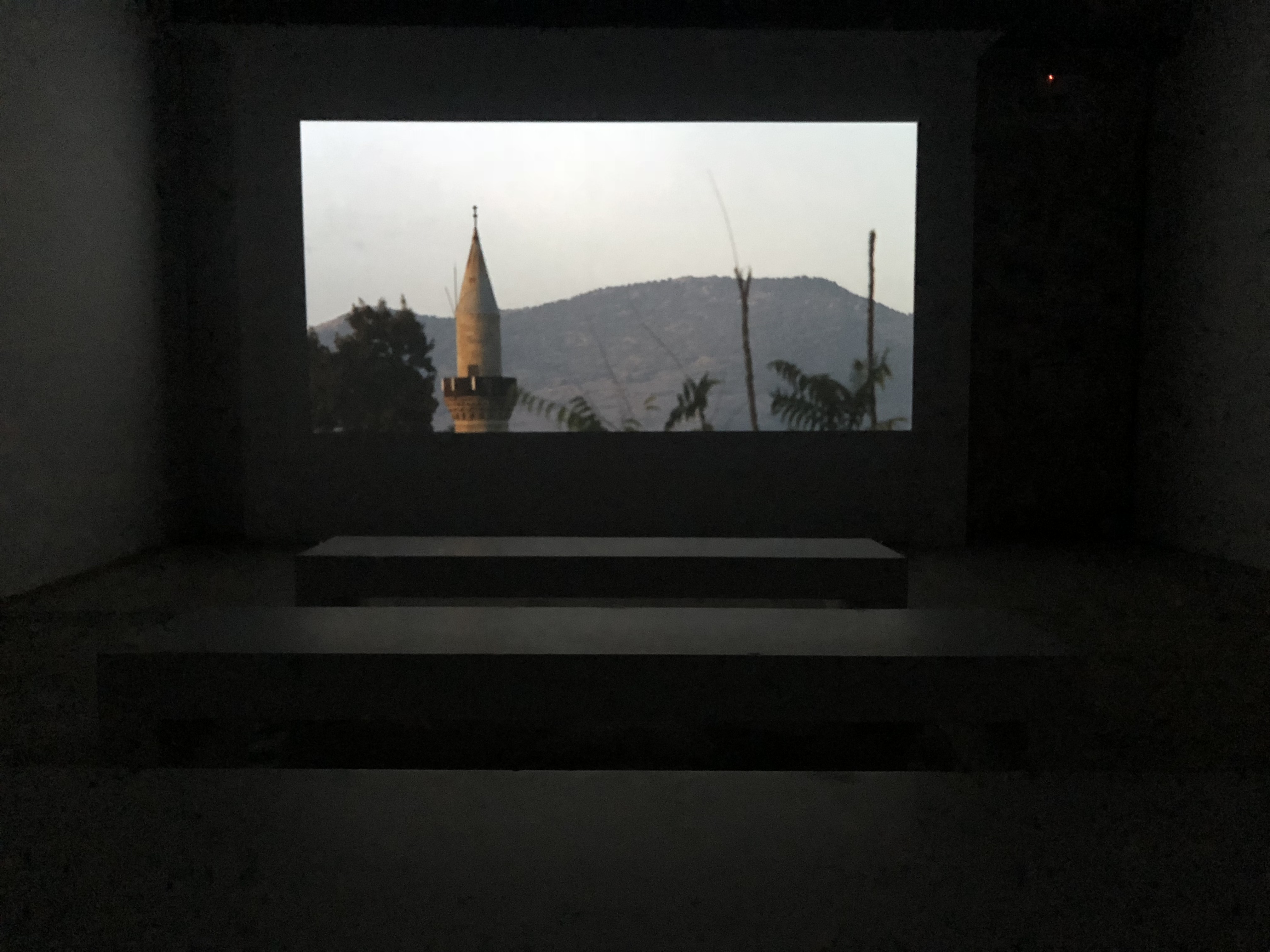
We spent quite a bit of time in NiMAC’s auditorium with Father-land screening. The wall onto which the film was projected faced approximately north, so it’s not too much of a stretch to ‘project’ that if the illuminated rectangle was a window the view would be not entirely dissimilar.
Geographer Jay Appleton, in his book The Experience of Landscape talks about the human response to being in a place of safety where one can look out into the landscape, framed as prospect and refuge. Our rooftop outpost above the Powerhouse Café allowed us a secluded vantage point to film over the Buffer Zone in a way that mirrored the lookout posts of the soldiers along the Green Line. Near Trikoupi Street, the guards’ feet were only two meters above street level but it was easy to miss them as they looked down on the passers-by below. As we began filming we were unsure of the etiquette around the Buffer Zone, nor the legal strictures since there were many signs proscribing filming the guard posts and fortifications in the south, and the Turkish soldiers to the north seemed even more forbidding.
The construction of the art centre meant that sounds from outside became imbricated with the soundtrack of the film. I was conscious that the amplified call-to-prayer from the north would be less remarkable to locals, but also perhaps unwelcome being repeated in the gallery as it is a sound that permeates the city every day. It was slightly uncanny hearing a constantly changing augmentation to the film’s audio – that is itself composed of the sounds of the city – by the sound filtering in from outside: the muezzin relayed from Istanbul reciting the adhan over loudspeakers on the Selimiye Mosque, pigeons on the window ledges, crows calling, people’s voices, construction and traffic noise. If I had thought of it I would have recorded the ambience from outside with the film’s soundtrack silenced…