

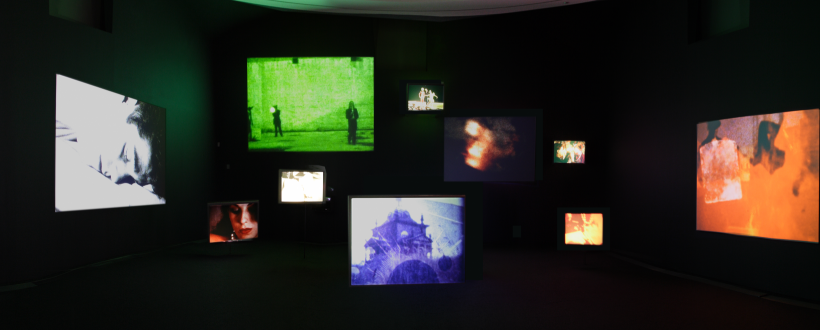
It’s ten years since we made a special trip to London to see the Serpentine exhibition which was curated by artist filmmaker Isaac Julien. There were several spaces in use: Blue was running in one room, Jarman’s paintings along some walls, some photos of Dungeness and a room with multiple projections of Super 8 loops. We sat on bean bags and saw some familiar work like the mirror plays from the Thameside flat, others were new to me. I had seen some of the material in the compilation work Glitterbug which was broadcast as an episode of Arena on BBC2 one evening. A gallery attendant stopped us filming the installation after a few minutes. It was lovely to see the work with Jarman’s sonorous voice filtering through from Blue.
The looped Super 8 in the gallery was a particular experience, perhaps not wholly satisfying. The screens were at different heights and sizes and for me the overall experience was engaging rather than anything more profound. I wouldn’t go as far as to say it trivialised the work but there wasn’t the engagement or immersion I would have appreciated.
I think I first encountered Jarman’s work (that is his personal cinema’ rather than his features) in a touring programme by the Arts Council which came to Plymouth Arts Centre cinema. I remember being struck by Gerald’s Film which was slowed down, with the frame-rate maybe 3fps on screen, although presumably projected via a 16mm blow-up.
Jarman described the origins of his Super 8 practice as being the home movies his father shot, then being an early adopter of Super 8 when he was loaned a camera. This was a personal practice that ran alongside his professional work as a designer for Ken Russell’s The Devils and for the ballet. Also, he was a painter, writer and gardener.
Over the years I did also see his features in the cinema: Jubilee, Caravaggio, The Tempest etc. I remember going from the Arts Centre down to the Minerva for a few well-earned pints after the The Last of England.