Plymouth University Arts Institute brochure about last year’s Cyprus residency.
Father-land: troubled dialogues in a divided island
Words and pictures: Kayla Parker and Stuart Moore
The practice research conducted by Kayla Parker and her colleague Stuart Moore at University of the West of England, Bristol, investigates notions of home and (dis)placement in the divided island of Cyprus. Through intertwining subjectivities with political and social histories, the legacies of colonialism, occupation, and the Cold War, the research outcomes will be shared as an essay film, a poetic form of documentary that blurs traditional genre boundaries, being a form of non-fiction that employs fictional techniques.
Skimming the Archive
Single channel HD video work comprising three panes of Super 8 footage
The work interrogates the ‘digitised materiality’ of personal Super 8 film, contrasting the tactile presence of the celluloid archive with the malleable temporality of its digital afterlife, and more particularly the accessibility afforded by skimming many gigabytes of filmed material in a non-linear editing program.
The film was developed across the 31 days of March 2016 using a process-based methodology – each day I skimmed across the hours of footage until a single image arrested my attention (cf. Barthes’ punctum) then I appended the following second of film footage to a timeline. The three panes allude to the past, present and future.
This presentation includes the original One Second a Day and its three subsequent iterations where the camera footage clips are extended to two, seven and 20 seconds. As the clip-length extends the repeated image progression across the panes become less obvious. Skimming the Archive simultaneously celebrates the boundless possibilities of digital postproduction while lamenting the feeling that with ‘digital’ a work is never fully finished.
This project is part of my 3D3 practice-led PhD based at Digital Cultures Research Centre, UWE funded through the AHRC.
Babette Mangolte – 3 Landscape films, ICA London, presented as part of the Birkbeck Essay Film Festival 2017. Introduced by Laura Mulvey (seen dimly in photo top right) and Lucy Reynolds.
26 Mar 2017
There? Where?, dir. Babette Mangolte, USA 1979, 16mm, 8 mins
The filmmaker describes the first film, There? Where?, as “a naive look at Southern California by an outsider, and/or an essay on displacement through the disjunction of Californian images and off screen voices. Where is the location of these voices, here or there? Are the images near or far in relation to the voices? Are the images commenting on the images or vice versa?”
The Sky on Location, dir. Babette Mangolte, USA 1982, 16mm, 78 mins
Documenting seasonal changes across the American West, from Wyoming to Oregon, the second film, The Sky on Location, is an affecting meditation on untamed nature and the atmospheric effects of climate on the landscape. Weather and ambiance, the wilderness and the Sublime, Mangolte articulates the shifting ways of looking at Nature from the nineteenth to twentieth centuries, and her keen cinematographer’s eye captures an awe and reverence for the American wilderness. The Sky on Location confronts us with a vision of the natural world, translated into a palette of ambient colour and visceral mood.
Visible Cities, dir. Babette Mangolte, USA 1991, 16mm, 31 mins
Finally, in Visible Cities, two women looking for a home in Southern California realise, in Mangolte’s words, that “the single-family home [is] the locus of the exclusion of the other. It is also unaffordable. They both feel as if they are invisible citizens. They witness how the architectural landscape imposed on the California desert appears as a reversal of nature, where exclusive living, gated communities and segregation go hand in hand. They dream of escape.”
Mixed BW and colour archive film with contemporary footage
No diegetic sound, just high-quality voiceover interspersed with silence – three voices, one female. The shots of the landscape appear to be shot on colour Super 16 although grainless as projected there is a subtle but evident weave. Projection from Blu-ray with mpeg gop stuttering particularly on shots with sea in the upper frames.
I sat in NiMAC’s auditorium (where we hope to screen Father-land) watching the film. The clear narration filled the space. “We do not remember, we rewrite memory as much as history is rewritten.” (Chris Marker, Sans Soleil, 1982)
“Stefanos Tsivopoulos takes a photographic collection found in the public archives of the port city Cartagena as starting point for a poetic investigation on the questions of memory and forgetting, on the role that images play in the construction of history, and their relation to reality and historic truth.”
anamnesis, a recalling to mind, or reminiscence. Anamnesis is often used as a narrative technique in fiction and poetry as well as in memoirs and autobiographies. A notable example is Marcel Proust’s anamnesis brought on by the taste of a madeleine in the first volume of Remembrance of Things Past (1913–27). The word is from the Greek anámnēsis, “to recall or remember.”
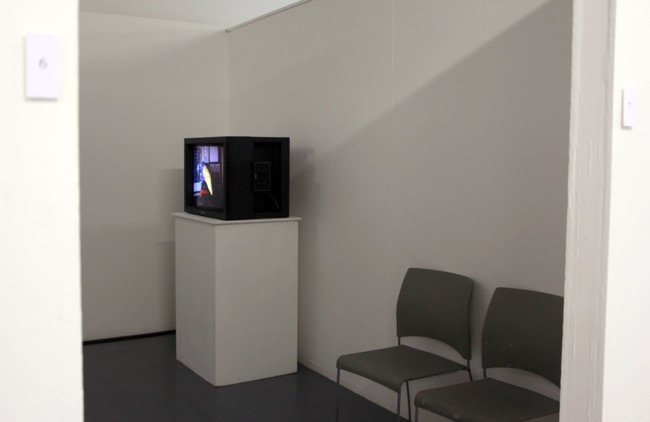
Womad (2016) was installed in the gallery space using a 27” Sony Trinitron cube monitor playing from a Raspberry Pi.
Womad looped on a Sony Cube CRT monitor at RWY.
The organisers needed some text for the catalogue and I wrote the following a few days before the opening:
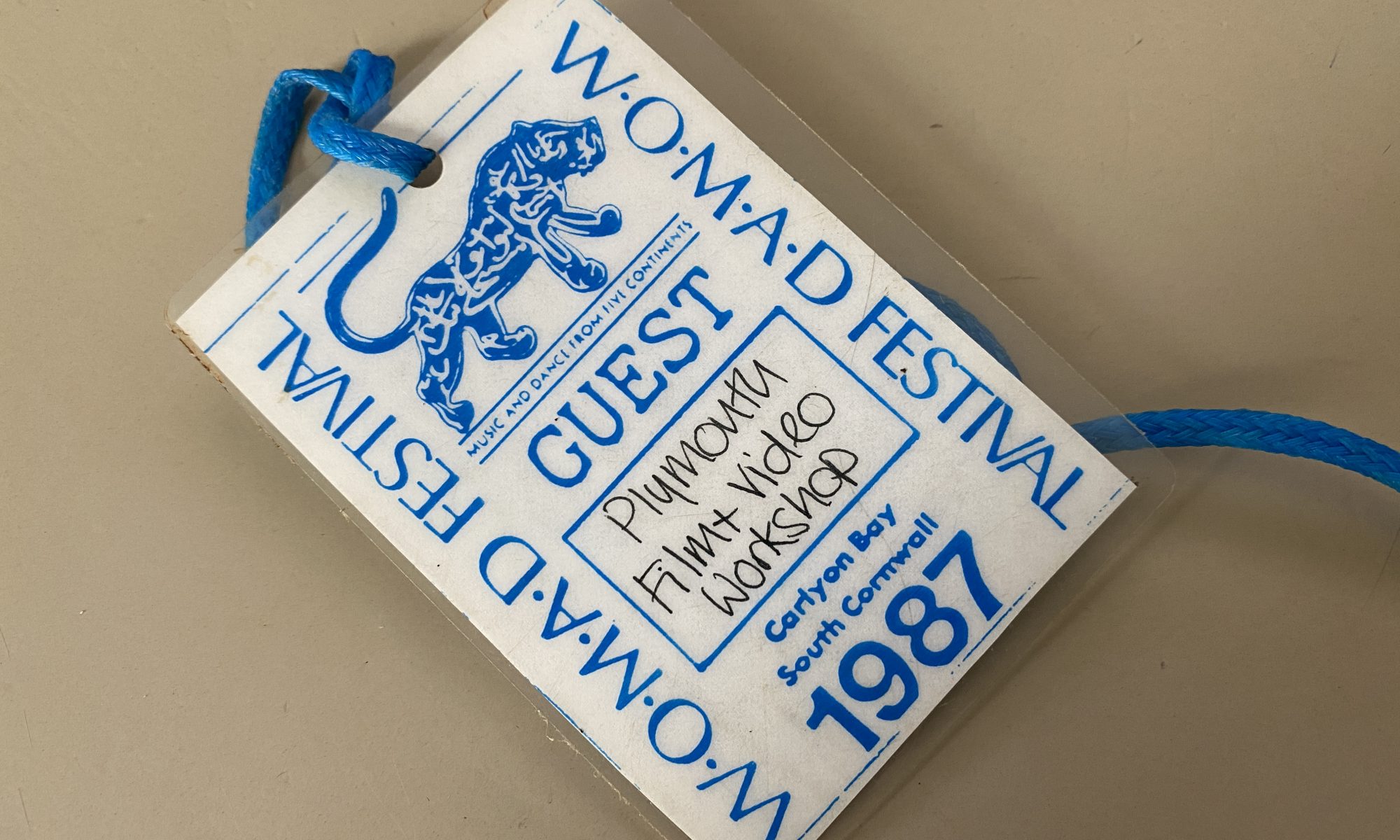
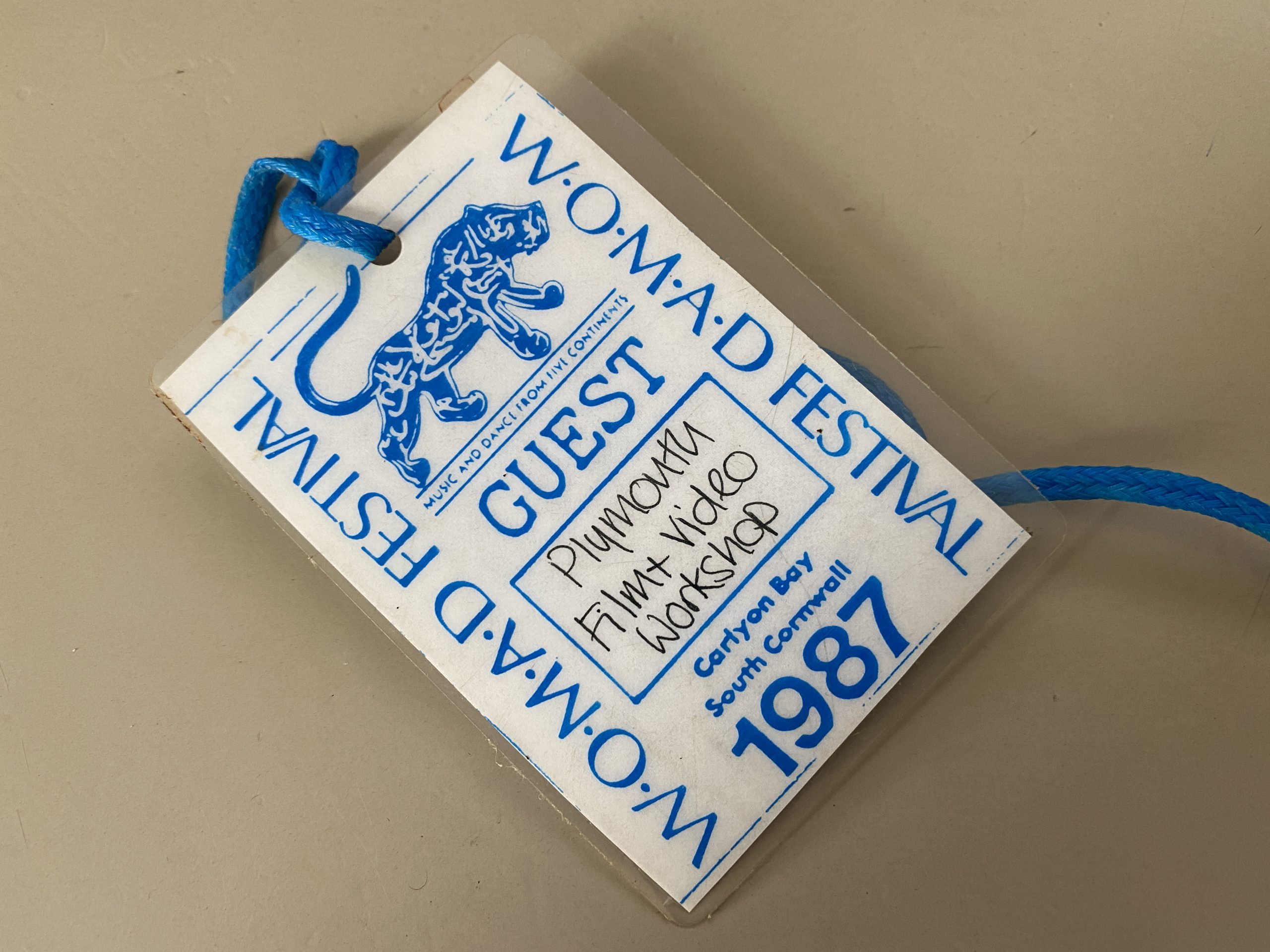
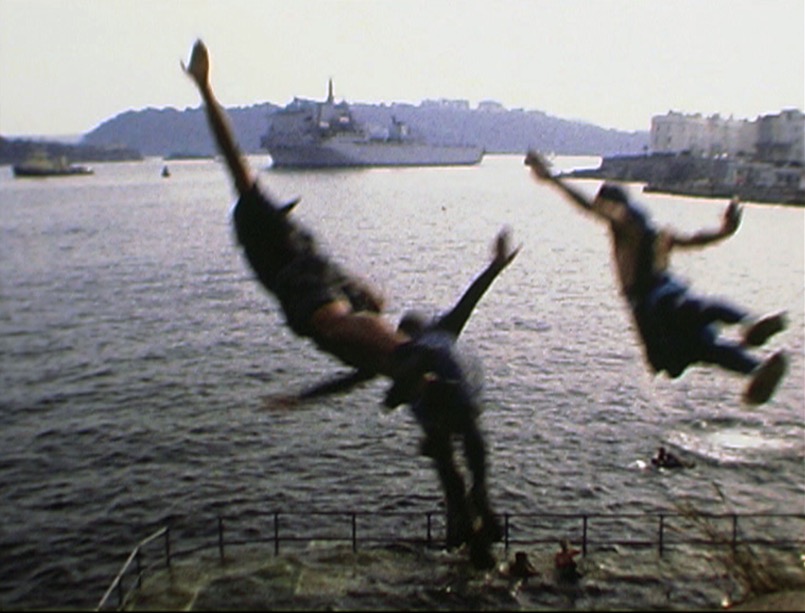
Womad Super 8 Colour, sound 9 min 30 Filmed at WOMAD 1987 festival in Carlyon Bay. The silent film was edited in camera and the contemporaneous audio was sourced from video recordings. We see the effect of time on the film material whilst the people have not aged, frozen in the sunshine of the past. Part of a PhD archival investigation; a collaborator shot one short sequence.
I thought about the text after it was dispatched and wondered whether it was a mistake to disclose the date of filming, anchoring the moving images to the calendar date which might have meaning for the audience outside of the film experience. The status of the work was perhaps changed to that of an historic document versus a ‘simple’ visual and auditory experience. One visitor had attended the event and disclosed this in the comments book.
The presentation of a new work using old footage is interesting. The context of producing work for this PhD is different to a producer looking for material to use in a documentary where the subject of the production would lead a researcher to seek out suitable material in an archive to illustrate their chosen themes. My practice is the opposite, using footage as an end in itself, whether it is visually interesting, or sparks some memory.
Guest pass issued for filming at the festival
The film was edited in camera and I was again reminded of Milena Gierke’s films. I have found a piece of writing(Accessed 27/09/16) from Directors Lounge, Berlin about Gierke’s practice:
“The tough decisions of choosing the right scene matching with the previously recorded images results in an incredible economy of resources, as the artists usually shoots with an 1:1 ratio of used film footage, unless some technical problems occur. At the same time, the in-camera edits often result in the classical unities of action, place and time, or even more so, the films represent the holistic perception of space and time at one location, in one situation. Each film breathes, happens at the present time, and at the moment of its showing.”
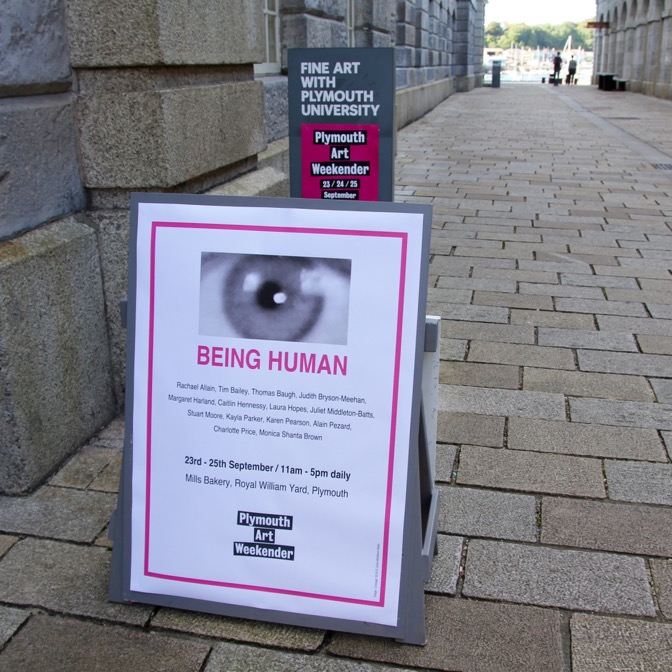
Womad has that 1:1 shooting ratio except for some very dark shots inside the auditorium which were excised. How different is the experience of viewing Womad at Being Human – digitised from Super 8, looped with a soundtrack on a video monitor with the artist not present – from Gierke’s projections? The take-it-or-leave-it approach (uncompromising) with by-appointment viewing is perhaps just one end of a continuum with unlimited online access being the other.
“At the same time the encounter stays ephemeral even in its conserved form on celluloid (since long replaced by the less romantic acetate), also because Milena Gierke is opposed to any reproduction of her films as stills, as she insists on the uniqueness of the film viewing experience during a screening.”
Womad (2016) has been screened for one evening at the CMIR 2 exhibition in Bush House, Bristol on Friday 1 April 2016 and now at Being Human 23—25 September 2016.
There’s also the programme note to Gierke’s presentation here regrettably only through the Wayback Machine.
Sea Front screened in Open Air Cinema, a short film programme curated by Anna Navas to launch the Sea Swim: Head Above Water touring exhibition at Peninsula Arts Gallery, a History Centre partnership project delivered by Peninsula Arts and Plymouth City Museum and Art Gallery, in conjunction with Plymouth Arts Centre; Tinside Lido, Plymouth (22 to 24 July 2016)
I attended the Birkbeck Essay Film Festival this weekend in order to gain insights into the essay film and to further my understanding of current academic perspectives of this ‘genre’ of filmmaking, which I propose to use to present my research findings.
Although the festival featured many examples of the audiovisual essay – a video lecture incorporating illustrative moving image extracts – the Festival of (In)Appropriation programme of experimental works created from appropriated archive footage resonated with my own approach and interests. This “showcase of contemporary, short audiovisual works that repurpose existing film, video, or other media in inventive ways” (Essay Film Festival, 2016) curated by Jaimie Baron proved to be something of a breakthrough. The works in the programme were exploratory and experimental in form, in contrast to the audiovisual essays, which functioned as self contained pedagogic packages for audience consumption. For me, as a filmmaker, the essential difference is that the author of the audiovisual essay occupies a position ‘outside’ their subject, whereas the essay film author speaks from a position of practice from within the work.
Held at Birkbeck Cinema, University of London, from 17 to 24 March 2016
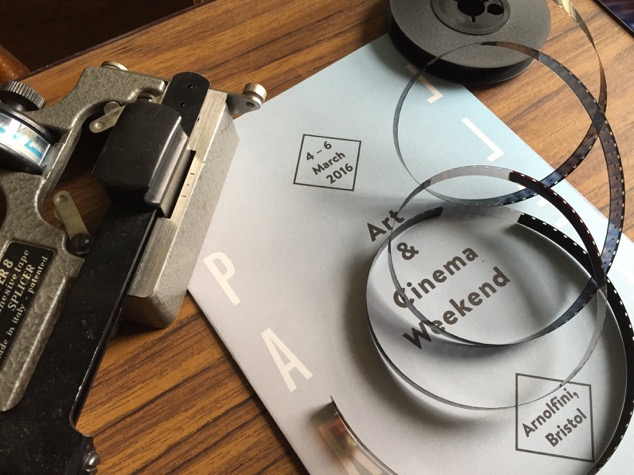
Stuart delivered a paper on Sunday 6 March at PARALLEL – ICO Art + Cinema Weekend 2016, hosted by Arnolfini, Bristol. The event was a festival of artists’ moving image, presented as part of the Independent Cinema Office’s Artists’ Moving Image Network project, in partnership with artists’ film distributor LUX.
The paper was part of the well-attended ’Bristol LUX Open Forum: First Person Plural’ session that considered responses to the questions ‘What is it about artists’ moving image which makes it particularly suited to first-person film-making? How can it articulate and help to influence a position beyond the self?’
Stuart’s presentation, ‘Archival Revival and First Person Filmmaking’, concerned authorship discernible to the audience from behind the camera. Can it be an essay film without voiceover or in a film which is not recognisably diaristic in form or intention.
Discussion around first person filmmaking – whether it’s necessarily a reflective, diaristic form, or whether it can be subjective essay filmmaking.
Impossible to do in-camera editing with file-based video devices as each clip is an island until dropped into a timeline. Discussion about film cameras being able to collect fragments of time onto a filmstrip.
Mentioned Charney “not just voyeurism, but voyeurism of loss, corpses on parade.” Photography has a medusa stare, instantly turning its subjects to stone. Film has the ability to create the undead. “Flat Death, is taken from Roland Barthes’ Camera Lucida which considers the photograph as a fixed record of a moment in time.”
Discussion around performance, and filming. Mentioned Bruzzi’s assertion that documentary is a performative practice, and not just where that’s overt e.g. Nick Broomfield.