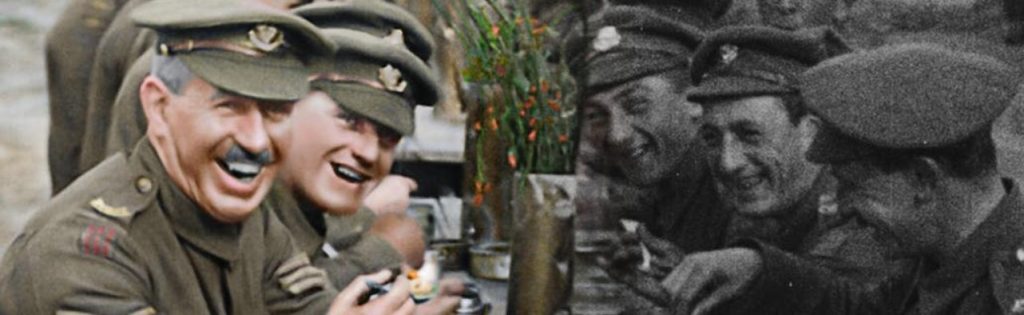
There is a fierce debate raging on CML’s [cml-film] under the thread title “Don’t call it a documentary”. It concerns the colourisation of WW1 archive footage by Peter Jackson in They Shall Not Grow Old. For some the colourised footage brings the soldiers and action to life, often suggesting that younger people can relate more strongly to the coloured lifelike representation. Others disagree and also point out that the original black and white footage is often viewed as extremely poor quality digitised copies.
Adam Forslund wrote: What is interesting to me is when I was a kid my grandmother (Born in 1921) and I were talking about dreams and she said “Sometimes I dream in Technicolor.” To which we had a long discussion about how she normally would dream in B&W. With science and history pointing out that humans have not always viewed colors the same way or at all. With all those that did see the war first hand gone then the war lives on in B&W. Colorizing film for me is not needed.
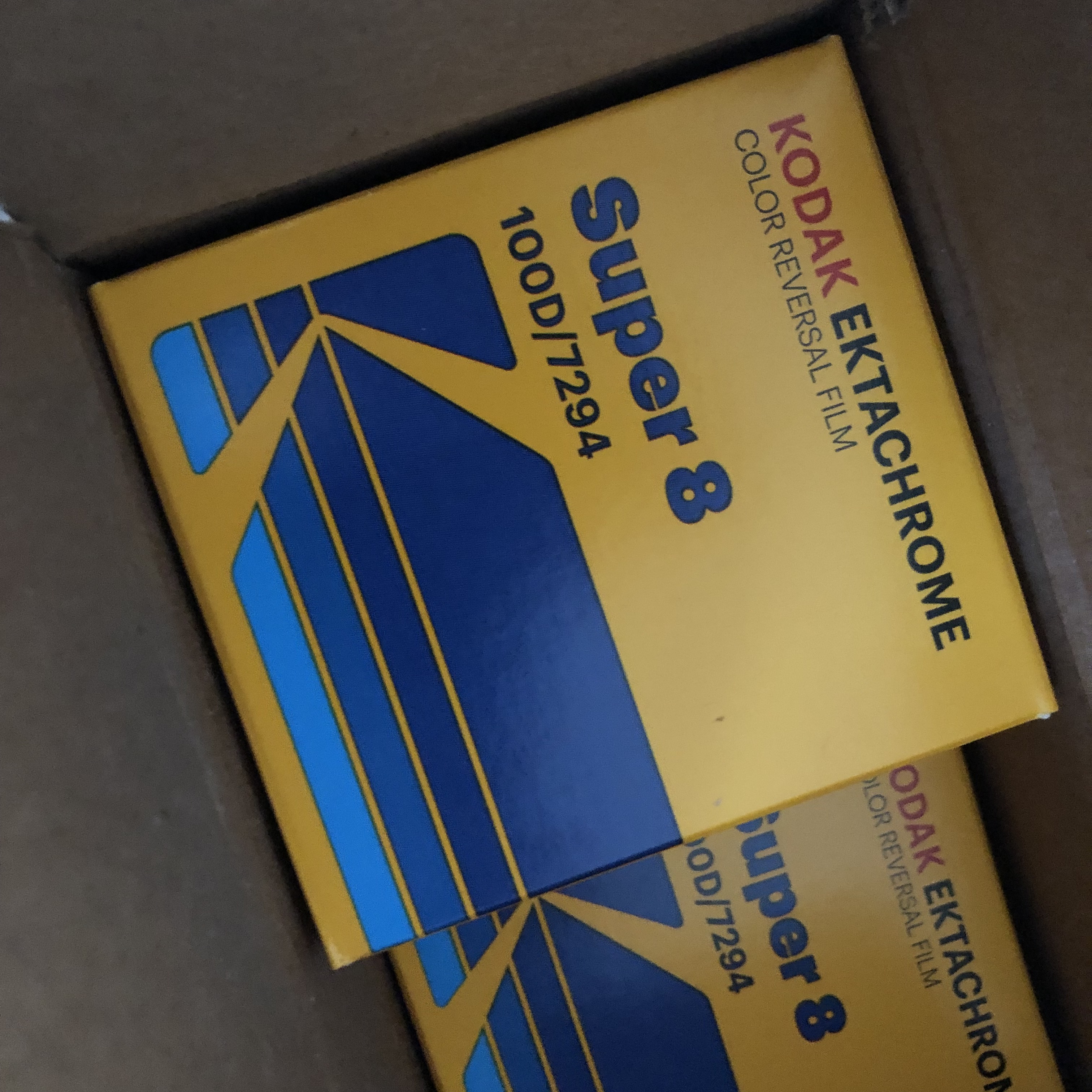
The release of the updated Ektachrome 100D 7294 has generated some interesting online material, including this Spanish site:
Google Translate’s attempt
Unpicking the machine translation I have:
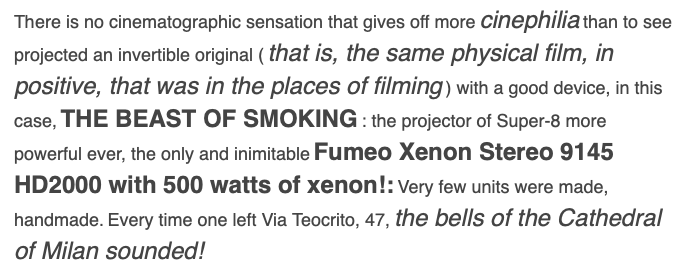
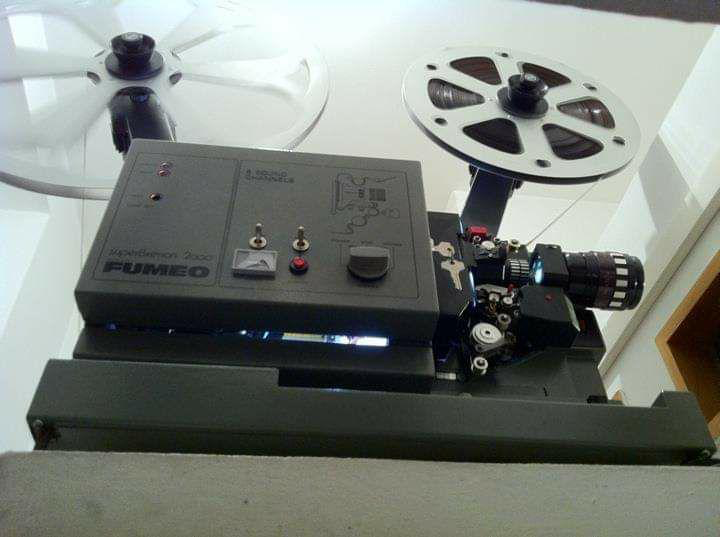
There is no more cinephilic sensation than to see projected a reversal original ( that is, the same physical film, in positive, that was in the places of filming ) with a good device, in this case, THE BEAST OF A FUMEO : the most powerful Super 8 projector ever, the only and inimitable Fumeo Xenon Stereo 9145 HD2000 with 500 watts of xenon!: Very few units were made, all handmade. Every time one left Via Teocrito, 47, the bells of Milan Cathedral sounded!
That harks back to my writing about the German filmmaker Milena Gierke projecting her camera originals – being there beside the camera’s gate in the past and the projector gate in the present.
In the film below at 13’ 48” Ignacio Benedeti Corzo states “if Kodachrome was the colour of the 20th century, Ektachrome is the colour of the 21st!”
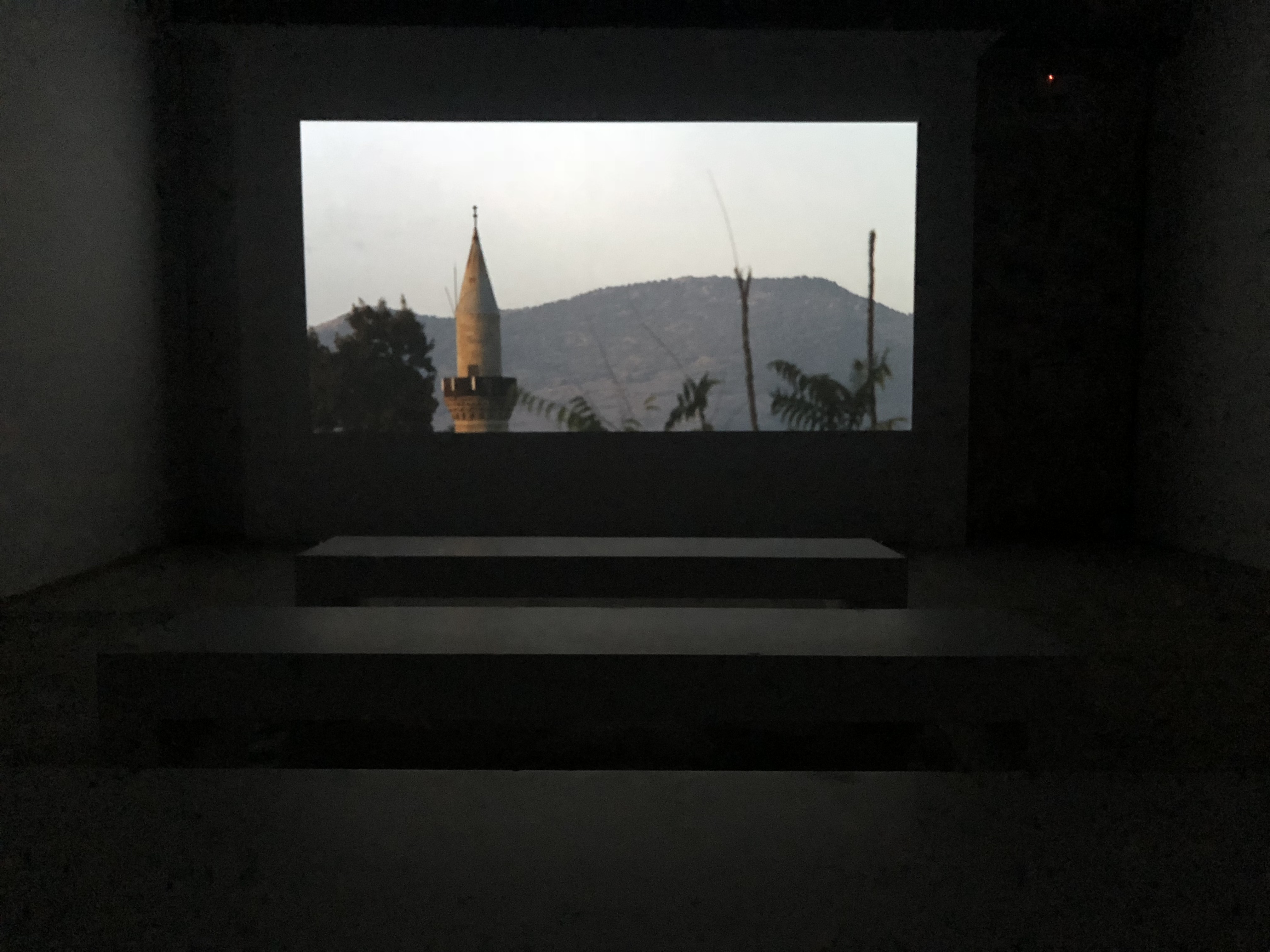
We spent quite a bit of time in NiMAC’s auditorium with Father-land screening. The wall onto which the film was projected faced approximately north, so it’s not too much of a stretch to ‘project’ that if the illuminated rectangle was a window the view would be not entirely dissimilar.
Geographer Jay Appleton, in his book The Experience of Landscape talks about the human response to being in a place of safety where one can look out into the landscape, framed as prospect and refuge. Our rooftop outpost above the Powerhouse Café allowed us a secluded vantage point to film over the Buffer Zone in a way that mirrored the lookout posts of the soldiers along the Green Line. Near Trikoupi Street, the guards’ feet were only two meters above street level but it was easy to miss them as they looked down on the passers-by below. As we began filming we were unsure of the etiquette around the Buffer Zone, nor the legal strictures since there were many signs proscribing filming the guard posts and fortifications in the south, and the Turkish soldiers to the north seemed even more forbidding.
The construction of the art centre meant that sounds from outside became imbricated with the soundtrack of the film. I was conscious that the amplified call-to-prayer from the north would be less remarkable to locals, but also perhaps unwelcome being repeated in the gallery as it is a sound that permeates the city every day. It was slightly uncanny hearing a constantly changing augmentation to the film’s audio – that is itself composed of the sounds of the city – by the sound filtering in from outside: the muezzin relayed from Istanbul reciting the adhan over loudspeakers on the Selimiye Mosque, pigeons on the window ledges, crows calling, people’s voices, construction and traffic noise. If I had thought of it I would have recorded the ambience from outside with the film’s soundtrack silenced…
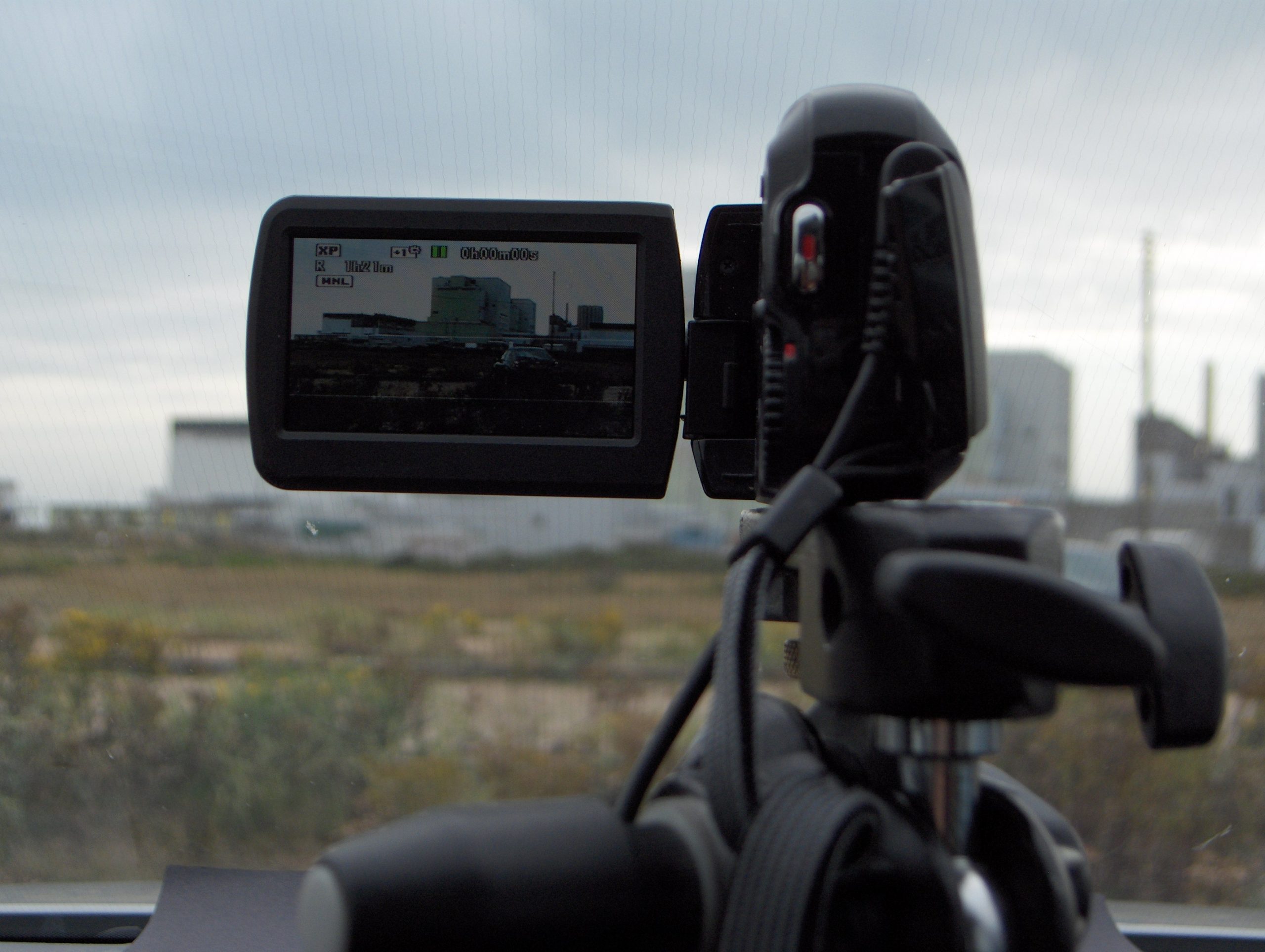
The final frame looking towards the power stations
I screened Missing Derek in the Scott 102 at Plymouth University. The 5-hour film played on a loop. When working in Kent in the 80s and 90s I was transported along A-roads and motorways across the width of England. After the quiet frenzy of getting ready to leave – both personal gear and the filming kit – you would settle into a ‘zone’ as the miles and hours rolled by in the crew bus. As we were physically transported over 300 miles one was also mentally transported by the ever-changing vista through the windscreen of the VW Transporter van.
The experience of motorway driving is similar to cinema, in that you have a fixed frame within which there is action – or the lack of it – but the sensorial experience is largely visual, as you are separated from the ‘outside’ within the vehicle, and the environment is perceived through the pane as images – like watching a film.
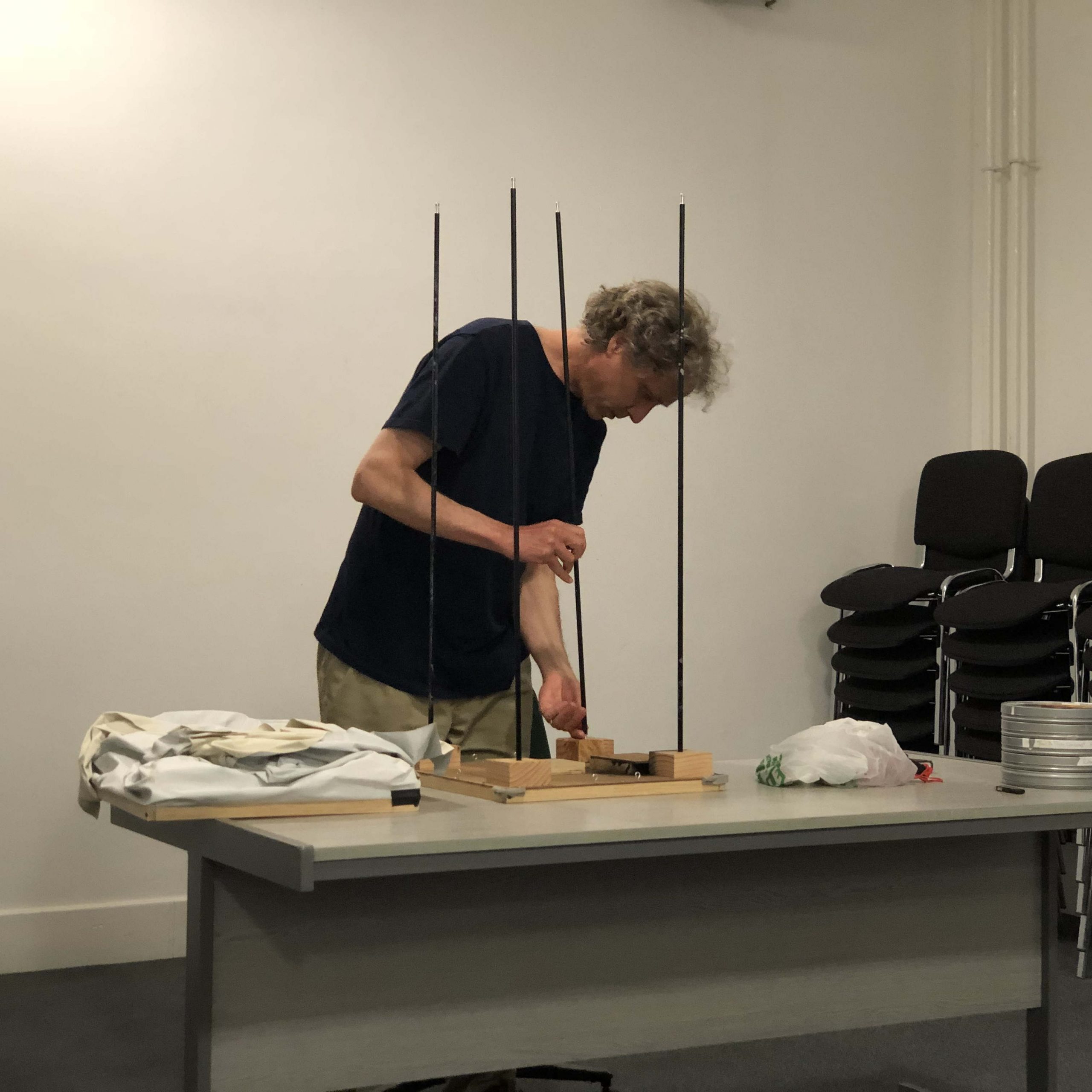
A screening and talk at Plymouth University, Robert Shaller had brought 16mm prints and some of his homemade 16mm cameras. Shaller was Stan Brakhage’s projectionist in Boulder, Colorado, USA. He visited to talk about his projects that explore the representation of landscape, projecting examples of his work from 16mm film. Marcy Saude kindly brought her projector as ours all have ‘issues’ and the university has none that are working.
Robert Shaller building an optical device.
The films were great and his low-tech cameras – one made from empty Kodak 16mm film boxes – caught the imagination of the audience. His devotion to the materiality of film was inspirational.
The event info: Robert Schaller the renowned American film-maker and founder of the Handmade Film Institute in Colorado, USA, will be here on Tuesday and Wednesday to talk about his projects that explore the representation of landscape, and will be using a 16mm film projector to screen examples of his work.
Wednesday 9 May 4.30pm > 6.00pm Room 102 Scott Building, University of Plymouth
About the artist: For more than twenty years, Robert Schaller has been making films that are fundamentally concerned with two essential aspects of film-making: the materiality of the film medium itself, and the creation of ‘visual music’ through applying the formal structures of music to film-making.
His approach is based on the fact that film, consisting merely of a transparent strip of plastic that can be held in the hand and seen with an unaided eye, is accessible to the artist in a direct and tactile way. He has been a pioneer in re-envisioning the industrial model of celluloid film-making into an embodied human-scale practice for the individual artist who seeks greater control of the means of artistic production.
His is an anti-consumer world of film-making in which the work of creating and re-conceiving the materials, tools, and methods of the medium on a personal non-industrial scale is as essential to the art as are the images light casts on a screen after passing through it.
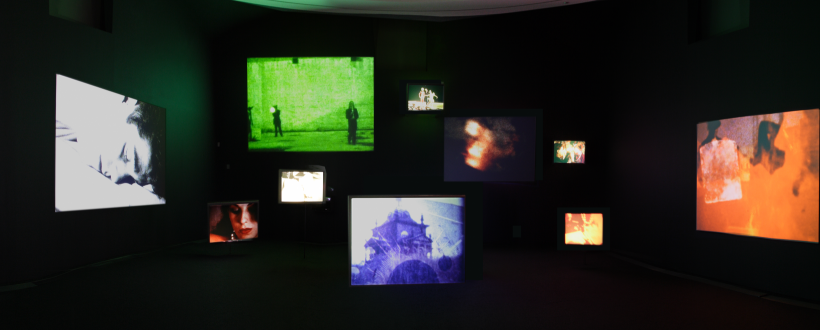
It’s ten years since we made a special trip to London to see the Serpentine exhibition which was curated by artist filmmaker Isaac Julien. There were several spaces in use: Blue was running in one room, Jarman’s paintings along some walls, some photos of Dungeness and a room with multiple projections of Super 8 loops. We sat on bean bags and saw some familiar work like the mirror plays from the Thameside flat, others were new to me. I had seen some of the material in the compilation work Glitterbug which was broadcast as an episode of Arena on BBC2 one evening. A gallery attendant stopped us filming the installation after a few minutes. It was lovely to see the work with Jarman’s sonorous voice filtering through from Blue.
The looped Super 8 in the gallery was a particular experience, perhaps not wholly satisfying. The screens were at different heights and sizes and for me the overall experience was engaging rather than anything more profound. I wouldn’t go as far as to say it trivialised the work but there wasn’t the engagement or immersion I would have appreciated.
I think I first encountered Jarman’s work (that is his personal cinema’ rather than his features) in a touring programme by the Arts Council which came to Plymouth Arts Centre cinema. I remember being struck by Gerald’s Film which was slowed down, with the frame-rate maybe 3fps on screen, although presumably projected via a 16mm blow-up.
Jarman described the origins of his Super 8 practice as being the home movies his father shot, then being an early adopter of Super 8 when he was loaned a camera. This was a personal practice that ran alongside his professional work as a designer for Ken Russell’s The Devils and for the ballet. Also, he was a painter, writer and gardener.
Over the years I did also see his features in the cinema: Jubilee, Caravaggio, The Tempest etc. I remember going from the Arts Centre down to the Minerva for a few well-earned pints after the The Last of England.
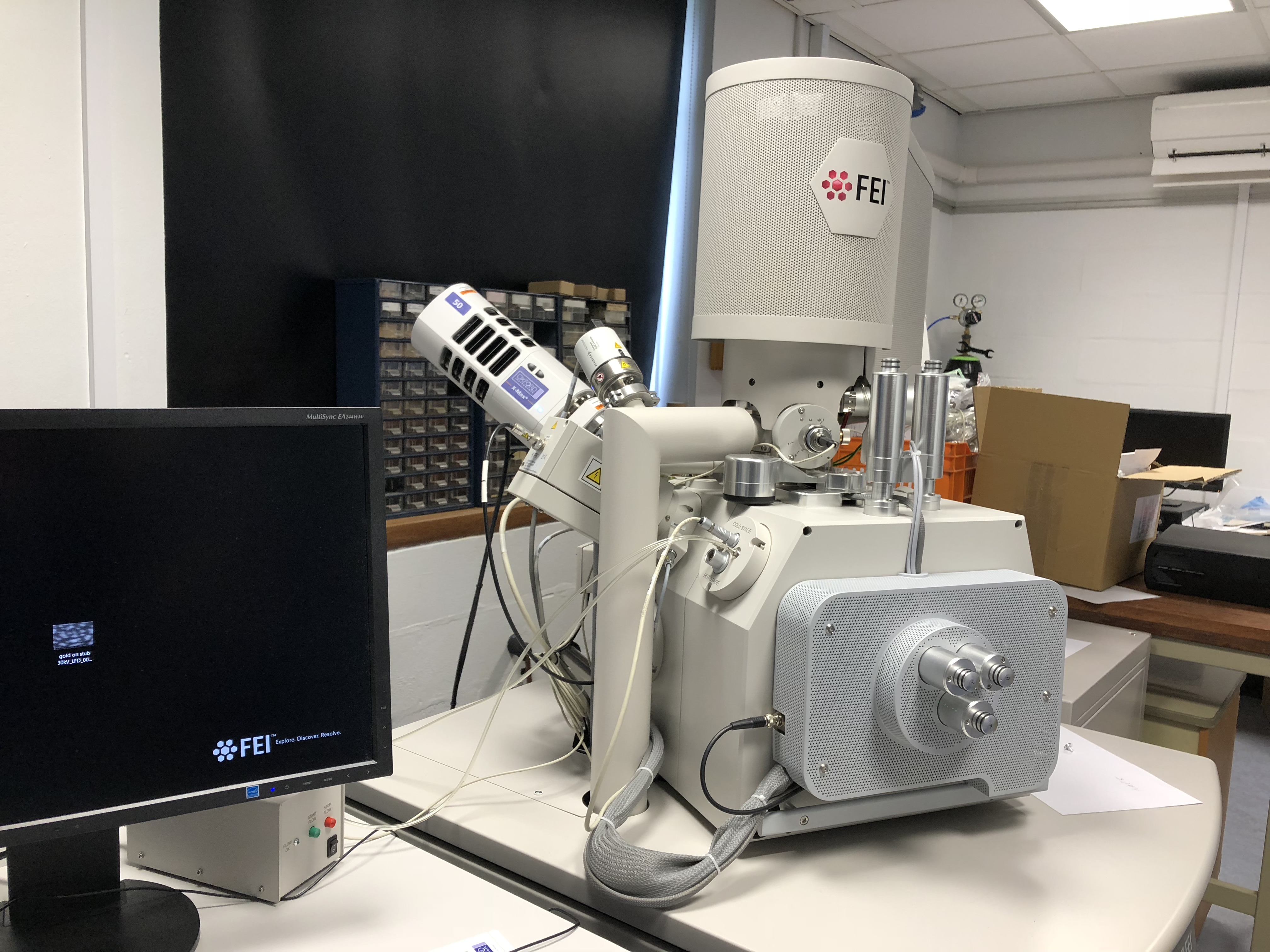
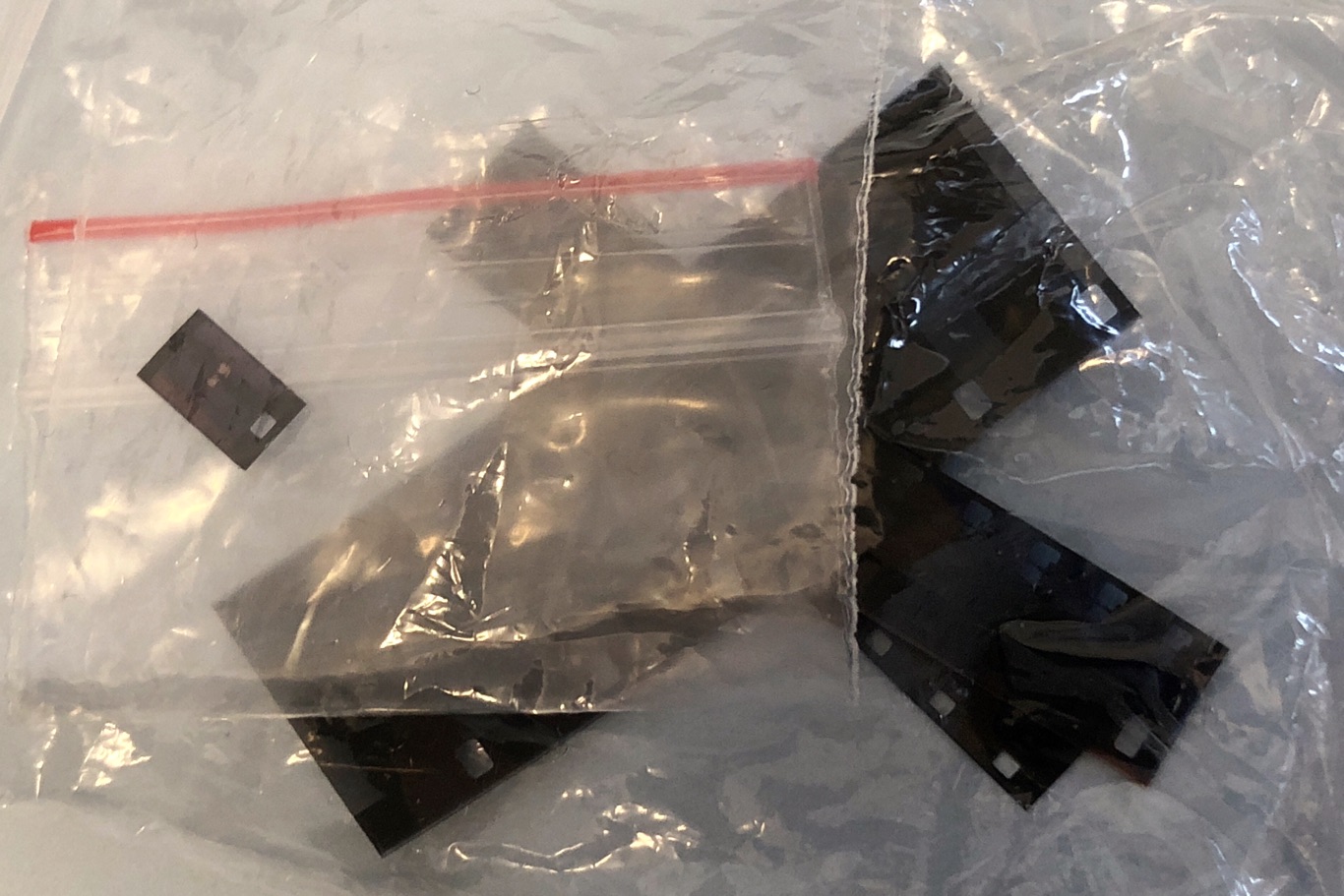
Today I took a strip of Super 8, a strip of Standard 8 and a strip of 16mm to the Plymouth University’s Electron Microscopy Centre. In a ziplock bag was also the single frame of Super 8 cut from the from the (physically) unedited Womad film – the act of cutting is in the video below:
The footage was shot as the journey of a flâneur along the coastal path – the liminal land/sea southern boundary of the City of Plymouth. The flâneur, in the modernist sense, seemed an appropriate stance for the filmmaker as the route traversed the varied and disparate results of urban planning, from the semi-derelict industrial to accessible tourist spots. Patrick Keiller suggests:
“The present day flâneur carries a camera” and warns of “the lonely life of the street photographer, who acts the flâneur in the hope of recording glimpses of the marvellous with his camera. His is a difficult task, for poetic insights so rarely survive their capture on the emulsion.” (Keiller, 1981/2)