LSFF and Stuttgart Filmwinter

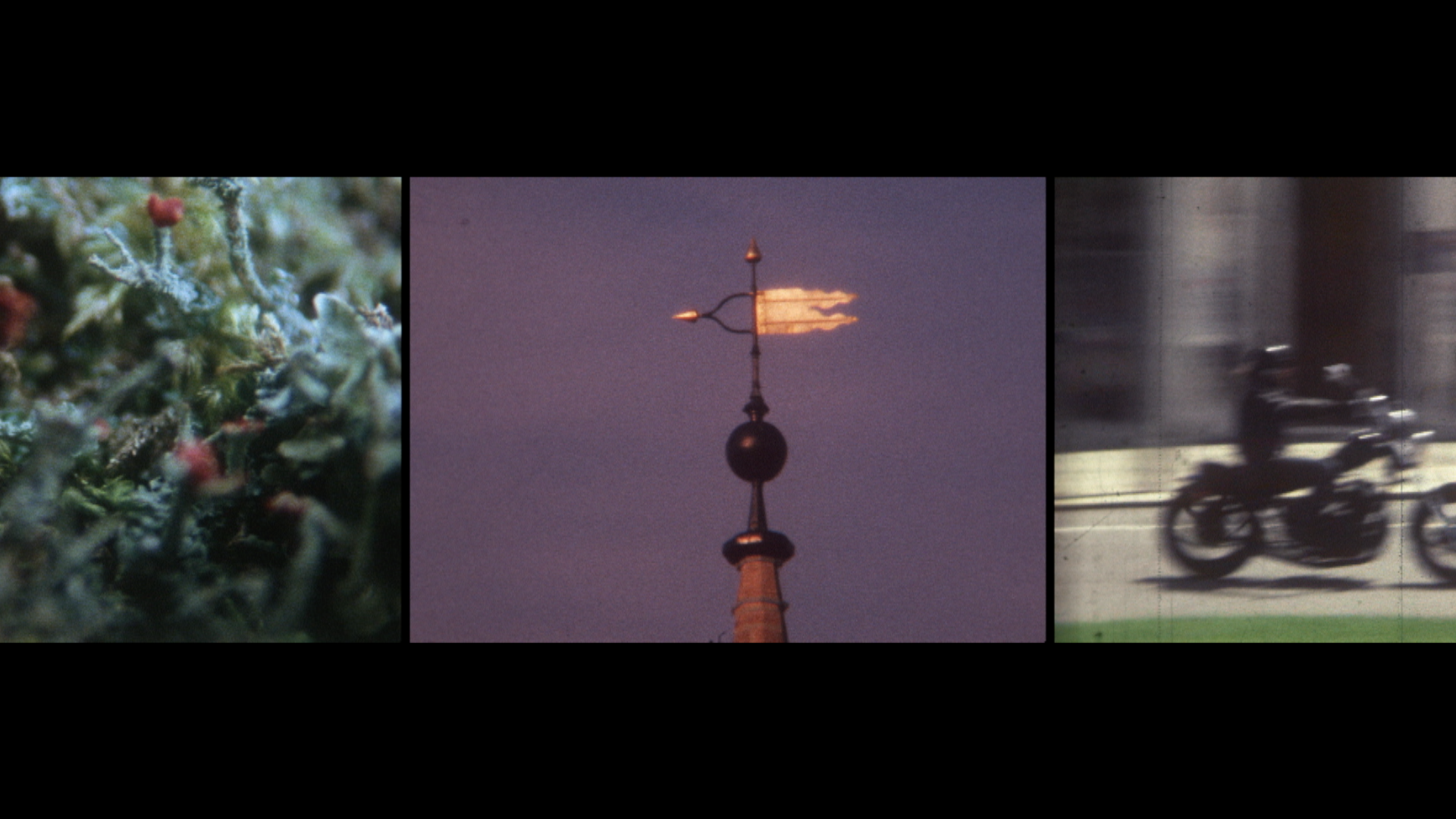
Screen grab from 31 Days

31 Days has been selected for London Short Film Festival and Stuttgart Filmwinter – the seven second-a-day version iterated from the original One Second a Day.

The entries needed extra information, metadata, for the film: stills, synopsis, CV etc.

“A triptych of film moments re-creates memories from a collection of thirty one clips, one selected each day during March 2016 from the artist’s personal Super 8 archive.”

Dylan Trigg’s ruins

Trigg describes the experience of ruins:

“The tension, surrounded by an aura of hauntings and spectrality, instils a threshold in the viewer: as much we attempt to commune with this immediate environment, so there is a sense in being watched by the environment.”

I wonder whether the experience of the Super 8 archives has parallels here:

“This reversible duality gathers a resonance thanks to the collision of worlds, spatial and temporal, with each diametrically opposed to the other. The reality of the traumatic event is not reinforced in this encounter, but instead trembles as an incommensurable void is given a voice between the viewer and the place.”

Visiting an architectural ruin may evoke the past traumas which took place there but the passage of time resists and distances, perhaps film can reanimate the past. The temporal bridge is perhaps stronger for the filmmaker who is both with the physical film in the present but also was present at the films’ creation/inscription. Super 8 film also bears the marks of its intervening traumatic life, a further indicator of temporality.

Seeing/finding myself at Womad in 1985 in Cornwall projected from Super 8 is a spectral experience, both in the sense of a ghostly apparition – visible but intangible – and through the spectrum of light filtered through the Agfachrome dyes. One can touch the film, mark the film, cast shadows by interrupting the projecting light, but the ghost of who and where I was 31 years ago is untouchable.

Bodies of Water

IMG_3603-2016-08-20-17-20.jpg

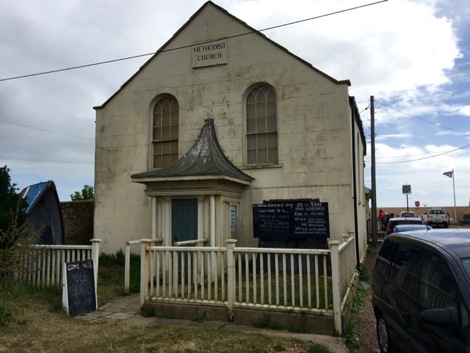
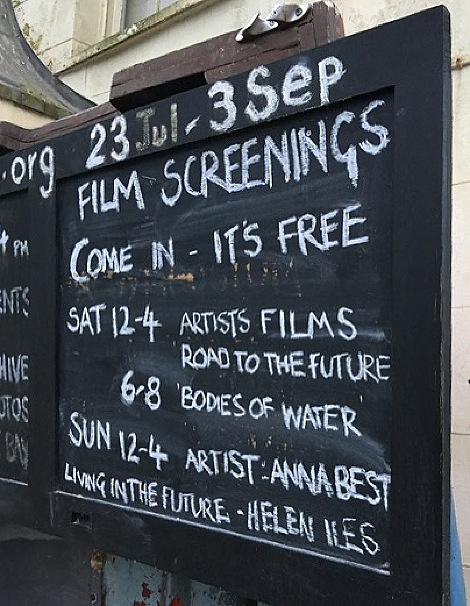
Sea Front and Teign Spirit were screened at Force 8’s Methodist Church residency in West Bay, Dorset tonight. The programme Bodies of Water was curated by Kayla Parker, originally for RWA Bristol’s Power of the Sea exhibition.

IMG_3604-2016-08-20-17-20.jpg

Sea Front was filmed on Kodachrome 40 in 2006 and made into the film in 2011 using digital audio recorded around the same time and location, but not simultaneously with the film footage.

Teign Spirit used HD video material recorded in 2009 layered with 8mm black and white footage filmed over several years until the final summer of 1939 by the Jones family on holiday at Teignmouth in the interwar years. Just as war loomed ahead for the Jones family contemporary Teignmouth is threatened by the vagaries of a changing climate, particularly to the low-lying Back Beach area whose houses open onto the strand.

Jaimie Baron describes as ‘problematic’ the seamless compositing of ‘found footage’ into new works, or the insertion of new elements into archive footage. Teign Spirit leaves the ‘seams’ visible so the audience is aware of the overlaying of archive material – recognisable both by its being monochrome and the clothing, vehicles etc clearly belonging to the past – on to bright, crisp HD digital material. The two types of footage combined generates the archive effect by the temporal disparity. The beautiful cine footage grabs the attention one moment, then the underlying colour video material catches the eye.

There’s a paradox in that the HD digital footage is identifiable as ‘non-archive’ but the creation of the film hinged on the realisation that we were recreating similar shots as the Jones’ camera operator/filmmaker. We are separated from the film footage by 70 years of calendar time but also by developments in camera technology. In another 70 years who knows how archaic the HD AVCHD files will seem?

31 Days

I had produced a new iteration of the 10 minute version of the “20 Seconds a Day” film which played as a backdrop to my presentation on Wednesday 4 May at Frenchay. The updated film has been selected for the BEEF Cephalopod screening at Supernormal 5-7 August 2016.
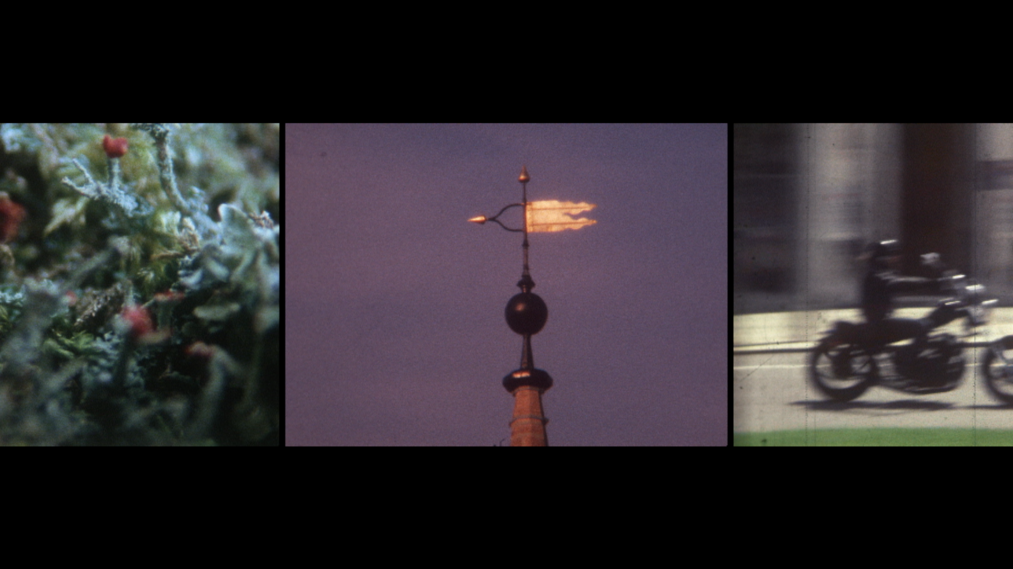
31Days1-2016-07-28-12-31-1.png

The original film comprised 31 one-second clips making a 31 second film. The presentation had a duration of ten minutes so I extended each one second clip to 20 seconds and removed one of the 31clips (30 clips x 20 seconds = 600 seconds or 10 minutes).
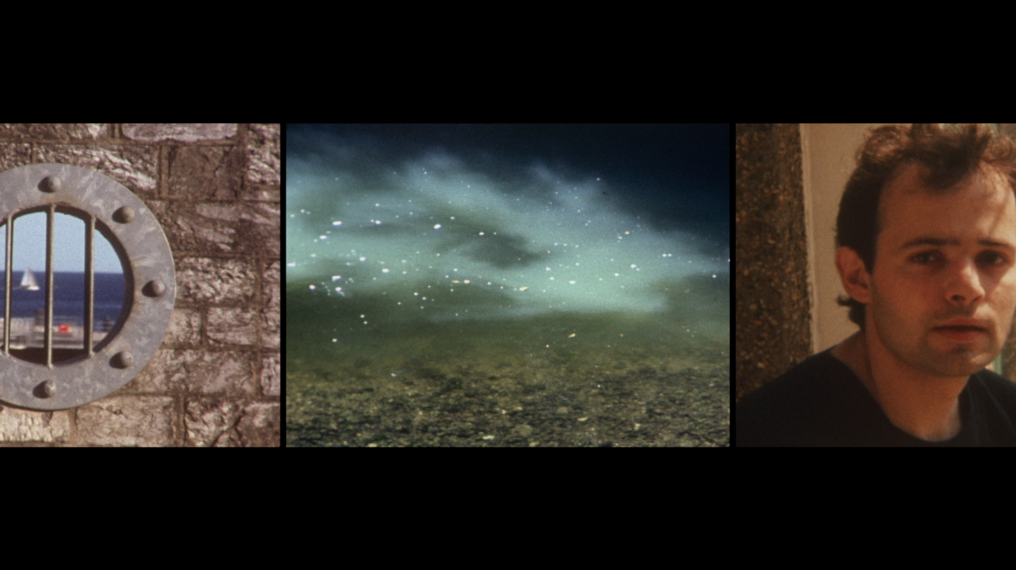
31Days2-2016-07-28-12-31-1.png

The reinstated clip brings the running time to 10 min 20 sec and is truer to the original methodology of choosing a clip a day throughout the 31 days of March 2016.

Super 8 cameras often have automatic exposure so filming can be somewhat freewheeling in execution: frame, focus and press the trigger. The cost of the film and processing has the opposite effect, encouraging frugality so shots tend to be fairly short. The editing technique of extending each shot by 19 seconds often revealed in-camera edits so the longer compilation film has many more than 31 shots. As the film progresses the intentionally arbitrary sequence of clips – initiated by the chosen one second a day shots – is further randomised by the inclusion of whatever is on the Super 8 strip/reel immediately afterwards. Following the initial one-second shot could be another similar shot filmed immediately after the first (or indeed a continuation of the first shot) or sequences from another time and location, whether edited in-camera or later with a splicer.
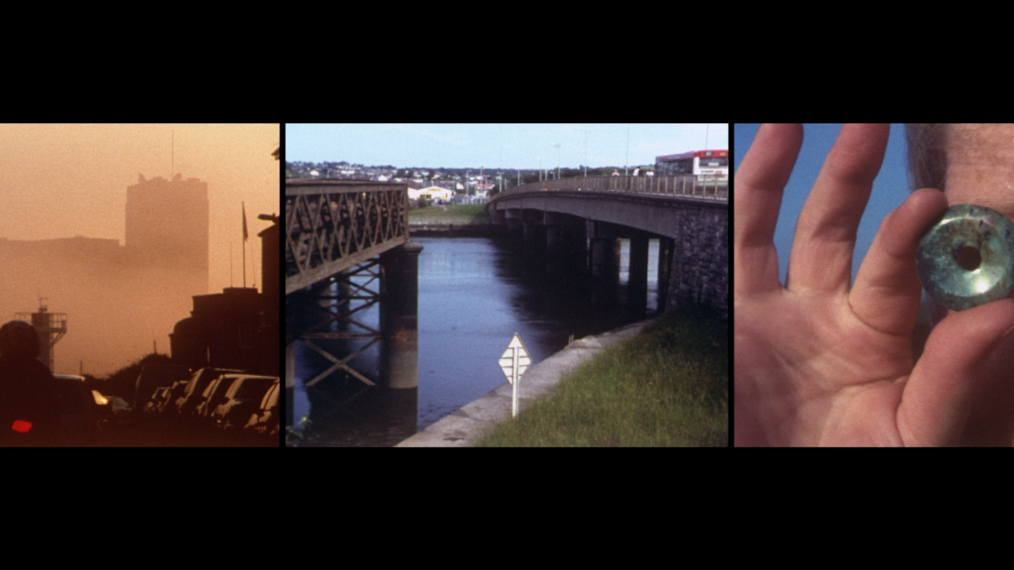
31Days-2016-07-28-12-31.png

These temporal and geographical/locational shifts in the film feel somewhat like remembering, where a memory of one event sparks others. The matter of in-camera editing came up at the Parallel Art and Cinema Sunday morning discussion in March in as much as digital cameras tend to be file-based so as soon as the recording camera is stopped the shot becomes a discrete clip in the device’s memory. The discussion was framed by two lecturers bemoaning the loss of a simple exercise for neophyte student filmmakers to take a video camera out and shoot a camera edited sequence which could be instantly played back in a seminar session.
Is this clip-centred paradigm a result of easy access to editing on computers where the need to cut up lengthy in-camera compilations would just add an extra step in ordering and rejecting footage, or possibly the opposite where the essentially cost free nature of the recording means that the documentation of an event would be more likely filmed in a long continuous shot? Walter Murch in The Blink of an Eye discussed explaining film editing at its most basic:

“Because, in a certain sense, editing is cutting out the bad bits, the tough question is, What makes a bad bit? When you are shooting a home movie and the camera wanders, that’s obviously a bad bit, and it’s clear that you want to cut it out. The goal of a home movie is usually pretty simple: an unrestructured record of events in continuous time. The goal of narrative films is much more complicated because of the fragmented time structure and the need to indicate internal states of being, and so it becomes proportionately more complicated to identify what is a “bad bit.”” {Murch, 2001, #50064}
In 2001 second edition of his book had been extensively updated to take account of the rapid move from physically editing film material to digitisation and computer editing. He remarked:
“In 1995, no digitally edited film had yet won an Oscar for best editing. Since 1996, every winner has been edited digitally-with the notable exception of Saving Private Ryan in 1998. 1995 was also the year that In the Blink of an Eye was first published in the United States. That edition included a section on digital editing as things stood at the time. It was clear to me then that the complete digitization of the moving image was inevitable, but the time frame for that transformation was not obvious and I looked at the situation with mixed feelings. At that time I also lacked digital editing experience.” {Murch, 2001, #50064}

Sea Front screening

SeaFront-StuartMoore300dpi-2016-07-22-15-09.jpg

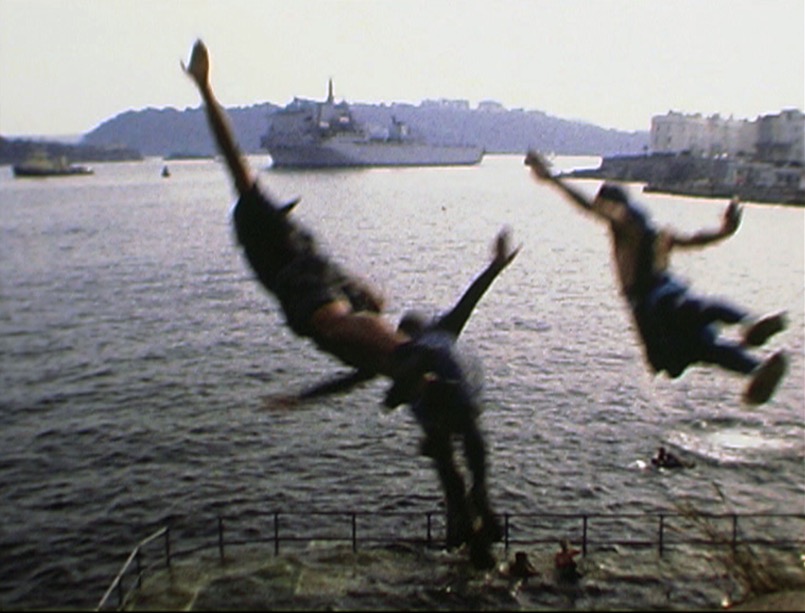
Sea Front screened in Open Air Cinema, a short film programme curated by Anna Navas to launch the Sea Swim: Head Above Water touring exhibition at Peninsula Arts Gallery, a History Centre partnership project delivered by Peninsula Arts and Plymouth City Museum and Art Gallery, in conjunction with Plymouth Arts Centre; Tinside Lido, Plymouth (22 to 24 July 2016)

ACE Postgraduate Research Symposium 2016

Title of Presentation:
Personal filmed material and the archive effect.

Abstract:
This paper reflects from a practitioner perspective on Jaimie Baron’s conceptualisation of the ‘archive effect’ (2014). In my presentation, I draw on my recent Practice as Research experiments as case studies in order to explore aspects of Baron’s theory. These new moving image artworks use extracted material from my own personal ‘collection’ of Super 8mm and 16mm film footage, which contains material captured over the last 25 years, in order to establish a critical position on my doctoral investigation.

1 Second Memories

The films sat in boxes for years. They were on a variety of reels, some on the original 50 ft Super 8 spools that were return from processing, others pieced together into bigger spools of several hundred feet. The splicing was with a strange zigzag cement splicer which gave visually appealing joints, both when looking at the film strips and when viewed on screen. The splices were very noticeable and served as a clear indication that one 50 ft roll had ended and another begun, quite the opposite of the invisibility normally required when splicing two shots together.

A lot of the material has been edited in camera in as much as a scene might be filmed in one or more shots which would then be inscribed on the film in sequence. The camera might then be unused for some time before the next shot is appended to the film producing a fractured chronology of image sequences perfectly edited together and not requiring tape or other clumsy interventions.

Super 8 cameras typically start and stop almost instantaneously so don’t ‘suffer’ from changes in exposure that can appear on 16mm and 35mm when starting and stopping the movement. The slightly acceleration of the mechanism can give overexposed frames each time the camera starts up. Some cine cameras – such as the Bolex EBM – have shutters which can remain open if its power is removed and the mechanism comes to rest with the gate exposed. This gives a flash frame caused by gross overexposure of the emulsion. Paradoxically these defects in the technology produce results which can be prized by some filmmakers as part of the ‘film look’, seen as an alternative or antidote to clean digital video footage. Super 8 cameras have an easier job pulling the narrow gauge film through the gate, and also have shutters which close after filming, partly as a result of often having stop motion ability as part of the feature set which could be advertised to potential consumers for the home movie system.

Contemporary digital (non-tape-based) cameras – whether stand-alone or built in to mobile phones, tablets etc. – are clip-based. Once the camera is recording and subsequently stopped the footage is stored as a standalone clip in a folder or collection/gallery. The possibility of the camera edit has been made redundant by the availability of nonlinear editing in the recording device itself or the expectation that the user has, and indead needs, digital storage and editing equipment.

Thoughts:

  • straight eight style competitions
  • The kink that formed when leaving film stationary in a S8 camera
  • The dodgy film pressure plate
  • Judder and weave
  • FCP X’s skimming in the browser
  • Makes footage accessible in way it never was with film viewers and projectors
  • Linear editing – in-camera
  • Film editing non-linear with spicer, Steenbecks etc
  • Linear in the age of deck to deck video editing
  • Strangely Super 8 is perhaps the most linear since it was fiddly to cut and splice although not impossible and there was a small industry catering to enthusiasts who wanted to use the tiny gauge film ‘professionally’.
  • metadata: a few films had basic names written on the reels
  • Most are filmic memories floating in time – of their time
  • Adam Laity thought Sea Front was much older than 2006
  • Charlotte Humpstone asked whether Womad had been filmed by my father since I appear in one shot
  • SWArts film award in 199? Still in progress – haha
  • students assumed projected Super 8 were ‘home movies’ in which I was included.

DN Rodowick’s the virtual life of film:

  • filmofanic?
  • thinking about film vs digital
  • his early writing in the book talks about experiences as a spectator in the cinema
  • Makes a distinction between the terms ‘cinema’ and ‘film’
  • Cinema studies in cultural studies
  • Interesting that my Super 8 films typically don’t have any audience
  •         ref Terry and recording material which is never even viewed
  •         not sure whether there’s much difference between a roll of processed film sitting in a box and an SD card which may or may not have video recordings stored

31 March – ghosts beneath us

31-2016-03-31-09-59.png
Wildlife pond at CCANW

The Sun reflected in the surface of a strange pool in Haldon Forrest car parking, near to the now-defunct CCANW – Centre for Contemporary Art and the Natural World. I think the centre was showing an exhibition by local artist Tabitha Andrews. As I was filming we were approached by Emily Allan – an ex-foundation student from PCAD – who introduced us to Paula Orrell, who was about to take up a curatorial post at Plymouth Arts Centre.

The CCANW website has been archived.

29 March – the past dissolves

29-2016-03-29-09-57.png

Grass caught in a fence on Dartmoor. We parked behind the Plume of Feathers pub in Princetown and walked towards South Hessary Tor. It was bitterly cold, Kayla carrying her heavy Bolex. I filmed with the weighty Canon 1014, using its lap-dissolve facility. The dried grass looked beautiful in the wind – it’s molinia and a real nuisance on the moorland.

What year was this? I’ve no idea. Maybe there is metadata with the film strip – not date and time, but implied metadata such as the film type. Perhaps shots before or after on the roll would give a clue. The lap-dissolves on the the grass tells me that it was filmed with the 1014 because its predecessor, in the sense that I traded one camera for the other, a Canon 814 didn’t have that facility. Now when did I buy the camera? Lees Cameras in London, and I remember using the 1014 at Beaumont Avenue before we moved out in 1994. So it could be any time after 1989…